

 Loading...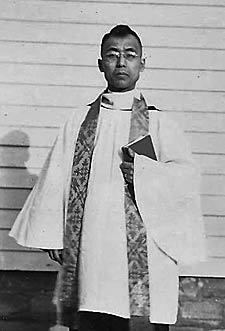
Sermon May 6, 2018
The Rev. Rebecca S. Myers, LSW
The Church of the Nativity and St. Stephen’s, Newport, PA
Sixth Sunday of Easter, Year B
//lectionarypage.net/YearB_RCL/Easter/BEaster6_RCL.html
This is my commandment, that you love one another as I have loved you. No one has greater love than this, to lay down one’s life for one’s friends. John 15:12-13
Please be seated.
One of my friends from seminary is The Rev. Steven Lee. Steven is from Korea. When I met him, he was taking a class or two at the seminary. At the time, I don’t think he was sure that he would follow the track for ordination. He also attended the church where I did my field work, Grace Church Broadway. I saw Steven frequently.
At Grace Church, he met the woman who would become his wife, Emma. One time after they had been dating awhile, I said to Emma that I thought it was time they get married. She laughed in agreement. I said if it was okay with her, I might just say something to Steven. I eventually did and it was soon after that, that Emma and Steven were engaged. I don’t really think it had anything to do with my encouragement, though. I do think it might have been in the works.
I’ve stayed in touch with Emma and Steven through Facebook. Steven is currently the Pastor and Vicar for the congregation of Saint Saviour at The Cathedral of Saint John the Divine in New York City.
Occasionally Steven posts photos and information about a gathering called EAST – Episcopal Asian Supper Table. It’s usually a wonderful and informative gathering. I contacted Steven about this upcoming service and he sent me some great materials, including a 32-page booklet from about 2014 entitled, Asiamerica Ministries in The Episcopal Church. It was in this booklet that I learned about Hiram Hisanori Kano.
Hiram Hisanori Kano was the son of a governor and member of the Japanese parliament. He was born in 1889. The politician and eventual Secretary of State, William Jennings Bryan, visited Hiram’s father in Japan and the family became friends. On that visit, Hiram learned about Nebraska, where Bryan was from. In 1916 after graduating with the Bachelor of Science in agriculture from the Imperial University of Tokyo, Hiram, with the support of William Jennings Bryan, was able to come to the United States and study at the then State University of Nebraska, now known as the University of Nebraska. He had been tutored in English from childhood, so did very well.
He spent his first summers in Nebraska working as a farm hand and was well known for how fast he could pick corn. He wanted to learn all he could about working the soil. After graduating with a Master’s degree in 1919, he bought a 300-acre farm. He married and he and his wife raised corn, oats, alfalfa, barley, chicken and cattle.
Hiram was also a Christian and he and his wife attended the Episcopal church every Sunday. He had nearly died at the age of 20 when appendicitis turned into peritonitis. He had a vision where he saw God. He said:
“I saw God. The visit was real, but I cannot tell what kind of form he was in, nor can I describe it with pen and ink. I was given a feeling of calm. I remember a pleasant feeling that my body was gaining strength.”
He was baptized and said he would go wherever God wanted him to go. In Nebraska, Hiram worked with the families who were Japanese. He was a leader and advocate for them.
In the early 1920’s, Bishop George Allen Beecher of the Missionary District of Western Nebraska discerned in farmer and educator Kano, the evangelist he was seeking to call Nebraska's Japanese people to be God's people. You see, in 1921, Kano and Bishop Beecher, successfully defeated a bill introduced in the Nebraska legislature that would have barred residents from Japan from owning property or serving as legal guardians of their children.
A lay missionary first, Kano became Deacon in 1928 and priest in 1936. By the spring of 1934 there were 250 baptized and 50 confirmed through Fr. Kano’s ministry. //satucket.com/lectionary/Hiram_Kano.htm
All was going very well for Father Kano. He was ministering to the people and enjoying the farm. Then came December 7, 1941. Father Kano had finished celebrating Eucharist at an Episcopal Church in North Platte Nebraska, which was 180 miles away from his family. He was immediately arrested by the local police. He was not allowed to contact his family. He was sent to the district attorney in Omaha. On the way, he learned about the bombing of Pearl Harbor on the police car radio.
Because of his connections with family in Japan, who were connected to the Japanese government, and because of his leadership in the Japanese-American community, he was rated as the most potentially dangerous of Japanese Americans. Even though he had been in the United States for 25 years and had a family and a farm, he was not allowed to be a citizen. Foreign-born Japanese could not be US citizens until 1952.
He tried to defend himself and his bishop also tried to defend him as a dedicated Christian and as a person loyal to the United States. Father Kano spent the next two years in internment camps in four different states. He viewed these places as his churches. He worked with the others who were interned, as well as imprisoned AWOL soldiers and German prisoners of war. He established a school and taught courses in agriculture and English. He preached the Gospel.
Even though he was the only person of Japanese descent from Nebraska interned, his daughter said:
“He might have been bitter in the beginning. But bitterness does you no good. It just wears you out. I think he figured out that the best thing to do is go with the flow and do the best you can.”
After his internment, it was determined that Father Kano should not immediately return to Nebraska. There was fear that he would face difficulties, because people would not know about his loyalty to the United States and the war was still going on. Instead, he attended and graduated from seminary in Wisconsin. He finally returned to Nebraska in 1946 after the war was over.
In 1952, he and his wife became citizens as soon as possible and then helped others of Japanese descent obtain their citizenship. When he retired, he and his wife moved to Colorado to be close to their daughter.
In his memoir entitled Nikkei Farmer on the Nebraska Plains, he wrote of his love for Nebraska. He was buried there.
At the end of his life in the mid 1980s, legislation began moving through Congress to provide reparations to people interned in camps during World War II. This legislation was eventually signed into law in 1988, 2 years after Father Kano’s death. But Father Kano told his Bishop, "I don't want the money. God just used that as another opportunity for me to preach the gospel."
Father Kano’s daughter created a scholarship in his name at the University of Nebraska. The webpage says that, “in the end, the fruit of the tree of this humble man’s life was this: Love.”
https://nufoundation.org/-/article-from-royal-roots-in-japan-to-humble-roots-in-nebraska
Oh that others would say the same thing about us at the end of our lives.
Amen
Other information on Father Kano: //plainshumanities.unl.edu/encyclopedia/doc/egp.asam.015
Asia America Ministries in The Episcopal Church: /digital_faith/documents/3251543