

 Loading...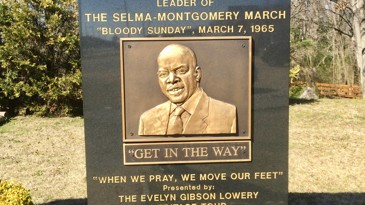
- Sermon June 2, 2019
The Rev. Rebecca S. Myers,
The Church of the Nativity and St. Stephen’s
The Seventh Sunday of Easter, Year C
http://www.lectionarypage.net/YearC_RCL/Easter/CEaster7_RCL.html#ot1
About midnight Paul and Silas were praying and singing hymns to God, and the prisoners were listening to them. Suddenly there was an earthquake, so violent that the foundations of the prison were shaken; and immediately all the doors were opened and everyone’s chains were unfastened.
Please be seated.
Last Sunday I wasn’t with you, because I had just returned from a pilgrimage to Civil Rights sites in Birmingham, Montgomery and Selma, Alabama. The pilgrimage was organized by the Union of Black Episcopalians or UBE of Washington, DC. We were named, Ambassadors of Healing.
While I had been to some of these sites over the years, there are new museums and memorials that I wanted to visit. Also, going with UBE presented a wonderful opportunity to be amongst Episcopalians and our friends; it suggested a trip centered spiritually.
I will be processing and learning from this trip for some time to come. One of the new museums we visited was The Legacy Museum in downtown Montgomery, Alabama. The museum was founded by the Equal Justice Initiative or EJI. It is designed to show how the legacy of slavery led to lynching, which led to Jim Crow, which led to today’s mass incarceration of People of Color.
At the very beginning of the museum, you see videos and maps teaching you about the domestic slave trade. In 1808, the “importation of slaves” was outlawed. Yet, slavery still existed in the United States. As had been happening for many years, children born of mothers who were enslaved, were also slaves. Virginia became the place that provided the most enslaved people from their Commonwealth to the “deep or lower south.” They had the largest domestic slave trade.
And in 1857 in Dred Scott v. Sandford, The Supreme Court ruled that the US Constitution did not apply to Black people, whether they were still enslaved or whether they were free.
The domestic slave trade is often known as the Second Middle Passage, the first one being the trip from the African continent to the United States. This Second Middle Passage was just as brutal.
People brought to Montgomery, sometimes marched on foot for hundreds of miles, were kept in pens, sometimes with the animals, as they all awaited being sold at auction. The Legacy Museum recreates these pens and using holographic imagery, brings the experience of those enslaved and held in those pens to life.
In one pen, a young boy and girl appear, continually asking for their mother. They were separated from her. In another pen, people appear and continually sing. Even as you look and listen to the stories in the other cells, you continually hear the singing from the first one.
The songs and the singing not only during that time, but throughout the Civil Rights movement, and I’d say even into today, were important and powerful.
Our group was fortunate to have tour guides at many of our sites who were alive and participated in the various movements. Some as young as 11 years old and others in their early or late teens. Now in their 70s and 80s, they provided a first-hand account of marching so their parents could vote or not using buses for over a year, so they could ride anywhere on the bus, or demanding equal access to all public facilities. They provided a first-hand account to the violence such seemingly simple requests elicited, including the deaths of their friends and loved ones.
We were told this movement was a spiritual movement with political and economic consequences. It was led from the churches, not from the political parties or businesses. The movement was grounded in God’s justice and in God’s love.
In todays reading from Acts, we hear a story of a young girl who was enslaved to two men, who received great money for her ability to see into the future. The two men did not see her as a human being. Like slave holders and oppressors throughout the ages, they only saw the money they could make through exploiting her talent.
Paul and Silas had been staying with Lydia in the city of Philippi. This young, enslaved woman would follow them around, proclaiming that Paul and Silas were bound to God and indeed offered salvation. After a number of days, Paul was able to get this to stop. We are told that the woman was no longer able to tell of future events.
The two men who had enslaved her, were not concerned about her at all and were furious with Paul and Silas. They were able to have Paul and Silas horribly beaten and thrown into jail.
And what did Paul and Silas do? Paul and Silas did what freedom fighters and Christians have done throughout time…they sang. On our pilgrimage we, too, sang…. O Freedom and We Shall Overcome and Ain’t Gonna Let Nobody Turn Me Around.
Paul and Silas sang. They prayed and they sang.
Yes, they were caught in a political system, accused of violating the laws of the community. They were jailed by the political authorities of the city. They had violated the economic system of the time that said it was perfectly alright for two men to make money from the talent of another person…that it was perfectly alright to enslave someone for your own economic gain.
Yet, Paul and Silas knew that all of this aberrant political and economic behavior, laws, and societal norms, was at its heart, a corruption of the spirit. A corruption of the soul.
That’s what Jesus Christ had taught them. Jesus Christ had taught them a way to live that fed their souls…that created communities where all could be soul fed. They knew going against the corruption of the world could get them killed, yet the liberation they felt from living in the way Jesus taught was so powerful, death did not scare them…death had lost its sting.
And that’s why the pilgrimage to these sites in Alabama was so powerful, especially being able to meet people who lived the Movement. The Civil Rights Movement was and is a spiritual movement, with political and economic consequences.
We are required by our love for Jesus Christ, who shed his blood for us, to work for and live in a world where all are free and soul fed. The prophet Isaiah says it this way in chapter 65:20-23:
No more shall there be in it
an infant that lives but a few days,
or an old person who does not live out a lifetime;
for one who dies at a hundred years will be considered a youth,
and one who falls short of a hundred will be considered accursed.
They shall build houses and inhabit them;
they shall plant vineyards and eat their fruit.
They shall not build and another inhabit;
they shall not plant and another eat;
for like the days of a tree shall the days of my people be,
and my chosen shall long enjoy the work of their hands.
They shall not labor in vain,
or bear children for calamity;
for they shall be offspring blessed by the Lord—
and their descendants as well.
At the one end of the Edmund Pettis bridge in Selma, close to where the march from Selma to Montgomery for voting rights began, there is a park commemorating the march. One of the monuments is to now-Rep. John Lewis. Then Rep. Lewis was with the Student Nonviolent Coordinating Committee or SNCC, who suggested the march as a way to press the politicians in Montgomery to ensure voting rights for all. The quote from Rep. Lewis that is on this monument says,
“When we pray, our feet move.”
May our praying move our feet to continue the work for God’s justice right here and right now, so that everyone’s chains will be broken and the doors to the prison will be opened.
Amen