

 Loading...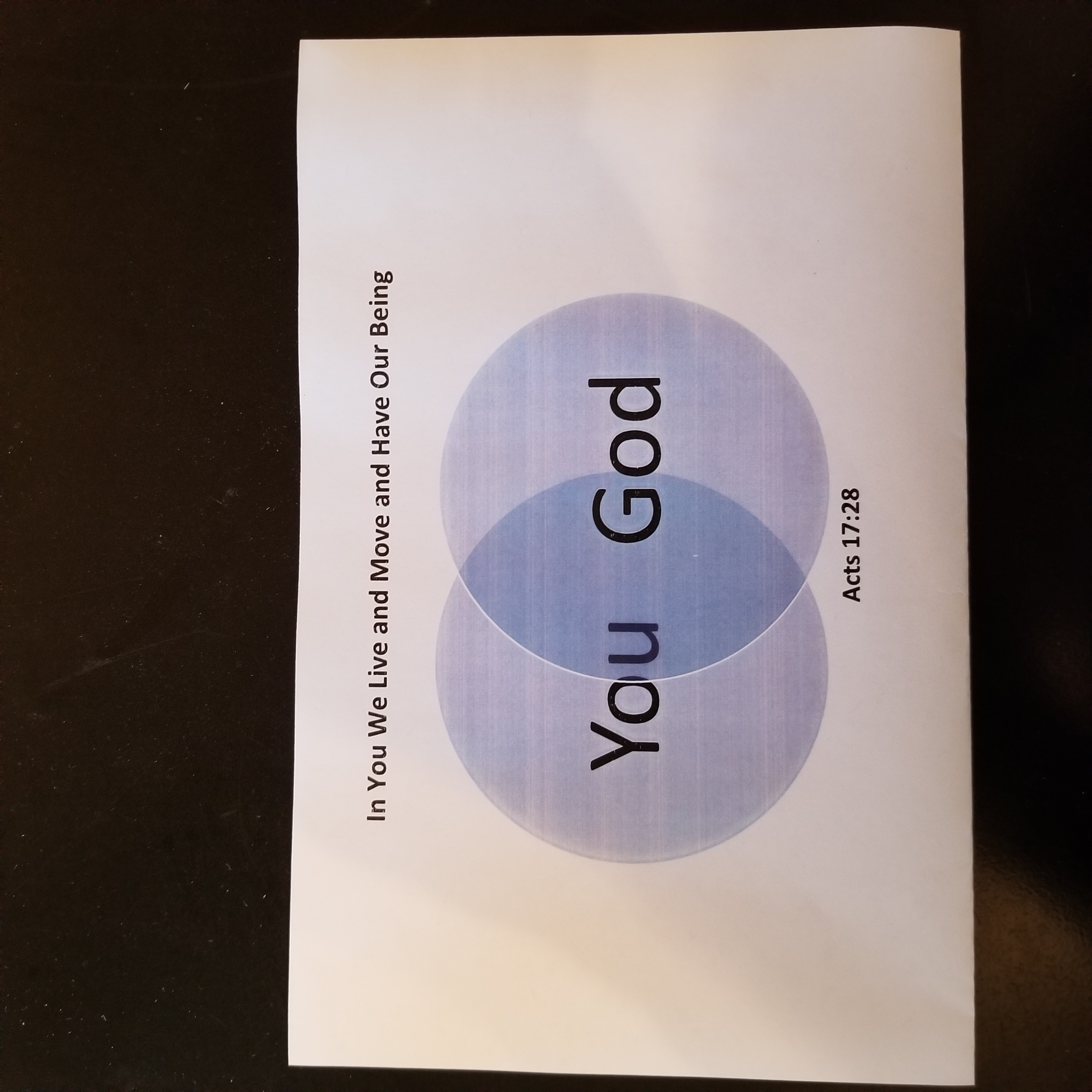
Sermon May 17, 2020
The Rev. Rebecca S. Myers,
The Church of the Nativity and St. Stephen’s
Sixth Sunday of Easter, Year A
http://lectionarypage.net/YearA_RCL/Easter/AEaster6_RCL.html
For “In him we live and move and have our being”; as even some of your own poets have said,
“For we too are his offspring.” Acts 17:28
A couple of years ago I was visiting my son and his family. My daughter-in-law, Leah, and my grandson Logan and I went for a walk. There were streets being added to their neighborhood and new homes being built.
Of course, we were curious about these new homes and there was one house that had all of the walls in. It wasn’t locked at all and we decided to go and take a look. Yes, it was risky, and I had done that before in my life. I loved the floor plan of the house. My grandson matter-of-factly said I should buy it so he and his sister could easily visit me. Oh, that melted my heart. But I replied that it would be quite a long commute to work.
I was reminded of this incident as I’ve learned more about the murder of Armaud Arbery in Georgia on February 23. Mr. Arbery was 25 years old and jogging. He stopped to look at a house under construction and continued on his jog, but moments later, his path was blocked by two men and Mr. Arbery was shot and killed.
As you may know or may have guessed, Mr. Arbery was African-American and the two men, a father and his son, were White. This incident occurred in late February, but no charges were brought until May 7. Mr. Arbery would have been 26 on May 8. The father and son said there had been robberies in the area and that Mr. Arbery looked like the suspect. They decided to try to arrest Mr. Arbery themselves, rather than call the police department.
Today we hear part of Paul’s discourse in the Court of Areopagus or Mars Hill in Athens. The line that stood out for me this week is a familiar one – “In You we live and move and have our being. This may sound familiar to you because in the Morning Prayer service on page 100 of The Book of Common Prayer, the Collect for Guidance goes:
Heavenly Father, in you we live and move and have our being: We humbly pray you so to guide and govern us by your Holy Spirit, that in all the cares and occupations of our life we may not forget you, but may remember that we are ever walking in your sight; through Jesus Christ our Lord. (p. 100)
Some of you may remember this Collect from the 1928 prayerbook, which is found on page 57 of our current book.
In you we live and move and have our being. As I pondered this, the venn diagram came to mind. Remember those diagrams that show circles in various patterns of overlapping? The ultimate living and moving and having our being in God would be, I suggest, the circles with no gaps – the circles completely together with each other. It wouldn’t be a venn diagram at all.
Yet, that’s perfection and our lives are more like that venn diagram, hopefully with more and more of our circle and God’s circle overlapping. If you drew the diagram for yourself, what would it look like?
That’s why the murder of Mr. Arbery, just the latest example of racially motivated violence, reminds us that we do not fully live and move and have our being in God through Jesus Christ. One of the places where our lives do not overlap with God’s teachings and word manifests as systemic racism.
In the case of the murder of Mr. Arbery, while we abhor what occurred, we distance ourselves from it. Some of us say, “well that’s the south. It’s like that there.” Some of us try to find something in Mr. Arbery’s past that might suggest the men who murdered him should not be punished. Some of us feel so overwhelmed by the very word, racism, that we completely shut down.
This past week, I joined a book group discussion on the book White Fragility: Why It’s So Hard for White People To Talk About Racism by Robin DiAngelo. The discussion is sponsored by the PA Council of Churches and led by their intern, Emily Schmid, who is a member of the Episcopal Service Corps. Ms. Schmid, until recently, lived at Sycamore House in Harrisburg. Micalagh Moritz, the Director of Sycamore House, also assists.
I had read this book and participated in a discussion of it at the end of March and most of us in that group said we wanted to go through the book more deeply, so this opportunity emerged. Honestly, I think you could discuss this book page by page. There is so much in it.
For the group that is meeting weekly on Thursdays, we are going through 3 chapters at a time and using a discussion guide which Dr. DiAngelo created. To better facilitate the discussion this past Thursday, which was held via Zoom, we were put into “breakout rooms” of three people each. We were supposed to choose a question from each chapter that we wanted to discuss and we had 20 minutes. Needless to say, my group only got through one question and it was this:
How do so many white people feel so confident in their opinions on racism, even as they live their lives in segregation? (Discussion Guide, p. 6)
Oh my, that strikes close, doesn’t it? Why do we who are perceived as and even identify as White feel confident in our opinions on racism or the murder of Armaud Arbery or the murders like it that have occurred, even as we live our lives in segregation? Because, let’s face it, where most of us live in Perry and Juniata Counties, we are very segregated.
We feel confident in our opinions about something about which we know very little. In looking at our own Venn diagram with God, there’s a part of our circle does not overlap with God’s part of the circle – the area of systemic racism. It’s an area in which we need to do better.
Even as we live very segregated lives, there are things we can do. The biggest one, I think, is to keep reminding ourselves that our personal lived experience as people who are white, is not the lived experience of everyone. We must continually remind ourselves of what it means to be in our communities and in the world in this context of whiteness.
We can take any of the areas in which we are passionate, i.e., trains, hunting, history, cooking, environment, and read about or learn about them from the viewpoint of People of Color. We can join organizations that are led by People of Color. We can continue to explore why so much segregation exists where we live…why the community is not more diverse. We can catch ourselves as we express confident opinions about things for which we know so little. We can adopt an attitude of curiosity and humility.
Because in the end, we want to live and move and have our being in the loving arms of God.
Amen