



 Loading...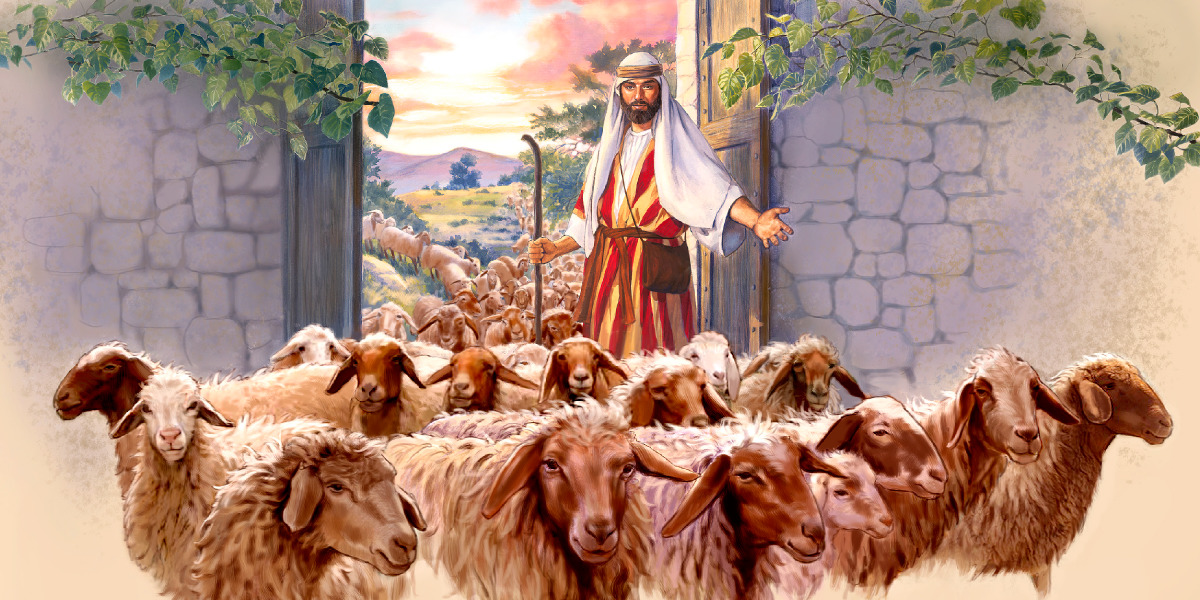
Sermon April 23, 2023
The Rev. Joseph Seville
The Church of the Nativity and St. Stephen’s
Fourth Sunday of Easter, Year A
http://www.lectionarypage.net/YearA_RCL/Easter/AEaster4_RCL.html
Audio: /documents/Eucharist__April_30__2023
Video: https://youtu.be/4ftqnUVJbeM
Fourth Sunday of Easter John 10:1-10
The one who enters by the gate is the shepherd of the sheep. The gatekeeper opens the gate for him, and the sheep hear his voice. He calls his own sheep by name and leads them out. (John 10:2,3)
Years ago, on a trip to Greece and Turkey I came upon a sign in English that stood out to me. I did not take a picture of it, which I now regret. The sign read, "Genuine fake watches!" Now there, I thought to myself, is an honest business! At least they don't try to hide the fact that that Rolex watch they have displayed in the window for only $19.95 is nothing but a fake! One man on the tour with us, though, actually went into the store to purchase a particular German name brand watch that he knew was fake, but really looked like the real thing, so he bought it!
Fakes are also a fact of life elsewhere. Hollywood mogul Samuel S. Goldwyn was reported to have said, "The most important thing in acting in honesty. Once you've learned to fake that, you're in." Forgeries are not restricted, of course, to tinsel town and art museums. The church has had its share of counterfeit prophets and artificial gospels down through the years. Voices which have called out "follow me" but which are hollow, and the directions they urged are not the pathways of Christ.
The church can often find itself wondering what is "the real thing" in terms of its life of faith and service. With so many forces at work all the time pulling it in different directions, it is sometimes difficult to know which way to go. There are any number of voices which claim expertise ofjust what the church should be doing in our day and age. "Do this or you'll lose generation x." "Do that or you'll become obsolete." Voices cry out at every turn. It can seem as if there is a crisis in vision and leadership.
This morning is sometimes called Good Shepherd Sunday because the Gospel is about Jesus referring to himself as the Good Shepherd. Actually, Jesus not only refers to himself as the Good Shepherd, He begins by speaking of himself as the gate through which one comes into the fold. In first century Palestine shepherds' flocks were sheltered at night in a communal walled enclosure. And no one who was not recognized by the gatekeeper would be admitted to the sheep. And so, obviously a thief would have to break in by another way. As the personification of the gate, therefore, Jesus was the only legitimate means of access to the sheep.
Beyond the personification of the gate, he then goes on to refer to himself as the Good Shepherd who knows and calls each of his sheep by name. One striking feature of Jesus' teaching here is his mention of voices. The sheep hear the shepherd's voice. They do not follow strangers because they do not know their voices. And not only that though, the shepherd calls each one of them by name. As the noted biblical scholar Walter
Brueggemann once observed, our God does not yell "hey you!' at us in a crowd. He calls us by our name. And we hear his voice through the words of Scripture as well as through the voice of another offering us insight, direction, and support.
These metaphors of gate and shepherd and sheep imply a vulnerability of the people of God to predators of various kinds. There are any number of things and influences which could and do lead one astray. And in Jesus' teaching this way, it served as a reminder to his little band of followers that as He would return to His Father in heaven, they could expect to be exposed to all sorts of unworthy human shepherds who would use their power over them for their own self-interest. Through using this metaphor Jesus was predicting that the tiny Christian communities in the first century were going to have to make their way upstream against strong currents of competing religious and ideological and political claims on their lives.
The "sheep" mentioned here in St. John's Gospel, were like the "children" St. Paul refers to in his letter to the Ephesians. That is, they are ones who are in constant danger of being "tossed to and fro and carried about with every wind of doctrine, by the cunning of human beings, by their craftiness and deceitful wiles." (Eph. 4: 13,14)
Across the centuries, the church has often been "easy pickings" for con artists, religious charlatans, power hungry manipulators, and misguided leaders. Many a flock has been "fleeced" by the unwise and the downright unscrupulous. But perhaps not since the first three centuries of the history of Christianity have ordinary Christians been pulled in so many directions as we are now, especially in this country, but competing religious and social and political and ideological "shepherds" as well. In various ways each offer to "change our lives" and put us on the road to happiness, success, self-fulfillment, moral and spiritual, enlightenment and recovery, and the salvation of our way of life. Or, perhaps they claim to be the only true way to understand and live out the Christian faith, claiming with certainty that they are right and everybody else is wrong. With the proliferation of channels on TV and other social media as well, our airwaves are filled with any number of voices proclaiming their understanding of the truth.
Voices call out, "Follow me" but the voices are hollow, and the directions they urge are not the pathways of Christ. Often times stubbornness can masquerade as strong faith, bigotry as purity, and the American dream of success as the gospel itself. Fraudulent leaders, misguided programs and distorted testimonies may and do appear often with little advance notice. Elmer Gantrys out to fleece the flock, or Jim Jones' with their selfdestructive messiah complexes, or Christian "ambassadors of reconciliation" who spew racism or contempt for the poor.
Sometimes such charlatans are relatively easy to spot. Most of the time, though, identifying the forgeries is a more subtle task, something like discerning a copy of a famous painting by noticing a slight variation in tint or a stray brush mark. Being able to discern becomes all the more important. And having a reliable voice to hear and return to becomes all the more critical if we are to ever hope to be faithful in our witness to Christ.
Tom Stoppard's play, The Real Thing, is about the human quest to find authenticity, the genuine article, "the real thing" in love, in art, in politics, and in all of life. He cleverly designed the play to throw the audience off balance by making the theater-goers unsure of their own ability to identify "the real thing." One of the main characters in the play, a man named Henry, is himself a playwright, and the story line creates a play within a play, intermixing scenes from Henry's plays with the "real" play the theatre audience had
come to see. The end result then is that everyone is left uncertain of whether the action they are watching on stage is something from a play by Henry or is it from the play they had come to see. Is the play they paid to see any more "real" than the play they did not expect to see? And what, the audience is then left to ponder, is "the real thing"?
Following the proper voice exclusively can be a tremendous challenge when we live in a society of so many options. Every day it seems more options are created. We clamor for the latest whatever because we are told it promises new pleasure or status. When we get through, though, we find that the pleasure is short lived or that there is already something new to replace it or that it doesn't live up to what is promised, so we clamor for the next whatever. And so, we can become something less than sheep as we listen for any voice that we might follow.
It is because conditions are this way in life that the role of the shepherd becomes so important for our livéand our witness in faith. Jesus is our Good Shepherd whose voice we follow.
"The sheep follow the shepherd, and not the stranger," Jesus said, "because they know the shepherd's voice." What distinguishes the shepherd's call from the voice of strangers or that voice that causes the sheep to run, in the case of authentic witness in faith, shares the cadence of Jesus' own work, Jesus' own promises and demands. It is the voice of Jesus that gives our witness in faith its true direction. It is the weave of Jesus' ministry that separates the wheat from the chaff. It is the shape of Jesus's ministry that distinguishes true sacrifice from sham and thievery in the name of God. It is the freeing saving, nourishing character of Jesus' ministry that defines what is real and true and good in the life of church.
That authentic ministry applies as much in our own personal lives as it does in the corporate witness to the faith. So, if sometimes you have trouble hearing the voice of our shepherd, our gospel today would remind us, be patient with yourself, because some days that voice of our true shepherd may sound loud and clear, and some days it may be nothing more than little nudge or whisper; some days it may sound like a love song and some days like a curse. And sometimes it is not always a voice that speaks in words at all, much less in sentences. But usually, it can be heard sometime between our getting up in the morning and our lying down each night, leading us beside the still waters, and restoring our soul. For Jesus came that we might have life and have it abundantly.
Amen.