

 Loading...
Sermon – September 27, 2015
The Rev. Rebecca S. Myers, LSW
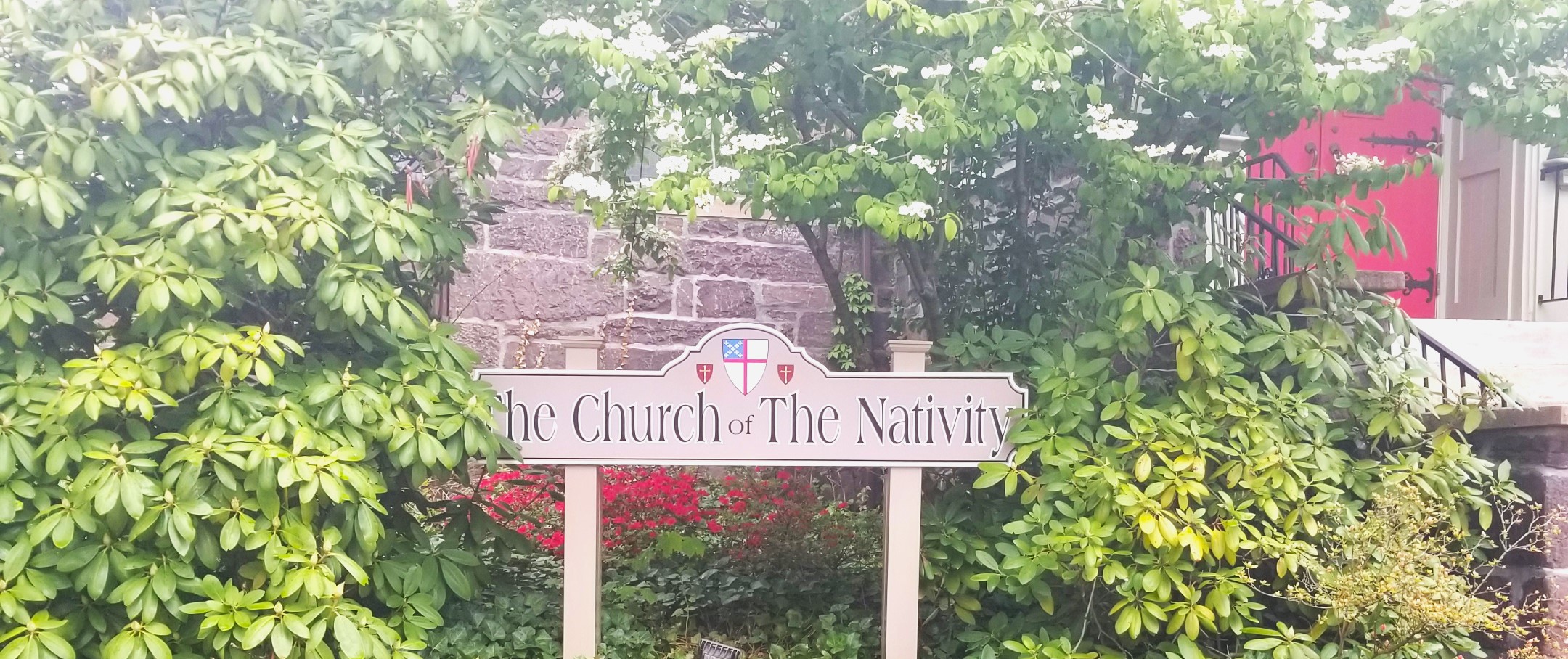
The Church of the Nativity and St. Stephen, Newport, PA
Pentecost XVIII Proper 21, Track 2
If any of you put a stumbling block before one of these little ones who believe in me, it would be better for you if a great millstone were hung around your neck and you were thrown into the sea. Mark 9:42
Please be seated.
In the summer of 2012, I had just finished two years of seminary education and was getting ready for my final year. Besides some travel to the Holy Land and Italy, I decided to return to Washington, DC for an internship with The Washington National Cathedral. I knew they needed help in the summer so all of the clergy could take vacations and since they were providing some support for my seminary education, I also wanted to give back.
While I could have lived with my daughter in Northern Virginia, a friend said she had a number of friends who needed house sitters during the summer. So I housesat for total strangers that summer, which is an interesting experience in and of itself.
Part of internship involved helping with Sunday services, including preaching. I also worked on a project regarding ministry with young adults. I read books, did research on the internet, and called people who were doing innovative programs in the area. I catalogued this research for the Vicar of the Congregation for further use, including programs and planning with the 20s and 30s group at the Cathedral.
I was given a small office in the library building on the Close. From the outside, it looked like a 1-story building, but upon opening the large oak door, there was a small winding stone staircase with a beautiful wrought iron railing up to a second floor. There were just a few offices on that floor and often I was the only person up there.
A staffperson had recently left the office, having left employment when funding for his program ran out. As is usual in these situations, I think, the previous occupant had left some small things behind…a few books and a pot with dirt in it, but no plant. In that pot with dirt, was a small ceramic bird – a toucan. The bird was that brown Central American pottery with very colorful painting on the bill of the bird.
A couple of times each week, people would climb those stairs to empty the waste baskets, vacuum and dust the offices. Often Elena came. She was about 5’5” tall with long black hair pulled back. She was close to 30. Elena would talk excitedly about the classes she was taking. She hoped to increase her English proficiency, although I thought it was wonderful, so she could pass the tests to enter college. I enjoyed our visits.
One day, a man came to clean. Miguel was about my height and in his 40s. We said hello and then I went back to my work while Miguel quietly cleaned the office. I’m not sure how it happened, but Miguel saw that ceramic bird in my office. “That reminds me of my country,” he said. Of course I asked him which country that was. He told me he was from El Salvador, where these birds were plentiful. I could hardly imagine how beautiful it must be there. We began to talk.
In the early 80s, I had taken a college course in Latin American Politics. While it focused predominantly on the conflict and war in Nicaragua, we also talked about what was happening after the war in El Salvador, especially with using the work of Brazilian Paolo Freire to dramatically increase the literacy rate in El Salvador. I was interested in Miguel’s experience and how he came to the United States.
Miguel spoke about his family and friends and told such a sad story. Many of his friends were killed by the government or by rebel forces. They were caught in the middle. I thought of Miguel’s mother and how grateful she must have been that he escaped.
Yet, I could tell that while he was grateful to be in the United States, he was also sad to be away from his country…away from his family…away from the forest and the birds. I felt blessed by his willingness to share his pain with me. I felt astonished that a simple remark about a ceramic bird led to such a deeply powerful and wrenching human story.
I told Miguel he should take the ceramic bird, but I don’t think he did. Maybe the memories were too bittersweet….
I didn’t learn about Miguel’s journey to the United States. I was sure there were many stumbling blocks along the way. I discovered he was learning to be more fluent in English and to read the language. I knew he supported a family that he loved. And I knew he came to the United States like so many immigrants – to have a better life and to save his very life.
Today we observe Latino/Latina Heritage Month. Many of you may recall that we used to say we were part of the ECUSA - Episcopal Church in the United States of America. We used to talk about “the national church.” We can no longer say that, because The Episcopal Church includes other countries and US territories. Those that speak Spanish include 2 Diocese in Ecuador, Columbia, Dominican Republic, Honduras, Puerto Rico and Venezuela.
In addition, ministry to people of Spanish speaking culture is growing in the United States. In the Diocese of Washington, for instance, where I was ordained, I was required to take a liturgical Spanish class in order to be ordained. Ministry to people from Spanish speaking cultures was growing quickly. Bishop of Washington, Mariann Budde’s consecration was bi-lingual.
You see, The Episcopal Church’s understanding of God, the Bible and being faithful is appealing to people all over the world. And having services in your native or first language and that arise out of your culture is a blessing and an essential way of connecting to the faith.
The truth is, however, that only about 16% of immigrants who are Spanish speaking do not currently know English. In other words, 84% of people from Spanish speaking cultures are fluent in English. In fact, 51% are bi-lingual and nearly 32% only know English!
And people from Spanish speaking countries and cultures are growing in our area, especially in Juniata County. In Pennsylvania, 6.3% of the population is Latino. In Perry County 1.7% of the population is Latino and in Juniata County, 3.1% of the population in Latino.
Those who migrate to the United States from Spanish speaking countries follow a similar path of the Italian and Polish immigrants in the early 20th century. They tend to work in businesses like restaurants, construction and landscaping in jobs where fluency in English is not as necessary. As a group, they work a lot, often having more than one job.
Yet, they face a number of stumbling blocks. For instance, in our area, many are from Puerto Rico. They are US citizens, but are not treated as such. Educational attainment and graduation from high school and college is a challenge. Jobs and the economy are important. Immigration reform is especially important for those who immigrated to this country.
Today we connect just a little with our brothers and sisters in The Episcopal Church whose first language is Spanish. I believe that hearing our familiar service in another language can help us open up to the lived experience and reality of the people who speak the language. As we open up, we hopefully will not be a stumbling block to them. Hopefully we will not stand in the way of their embrace of the faith we love so much and that feeds our souls. And maybe, the hymns today and the challenge of saying The Lord’s Prayer in Spanish will open us up to a deeper connection with God.
Amen