


 Loading...
Sermon September 18, 2016
The Rev. Rebecca S. Myers, LSW
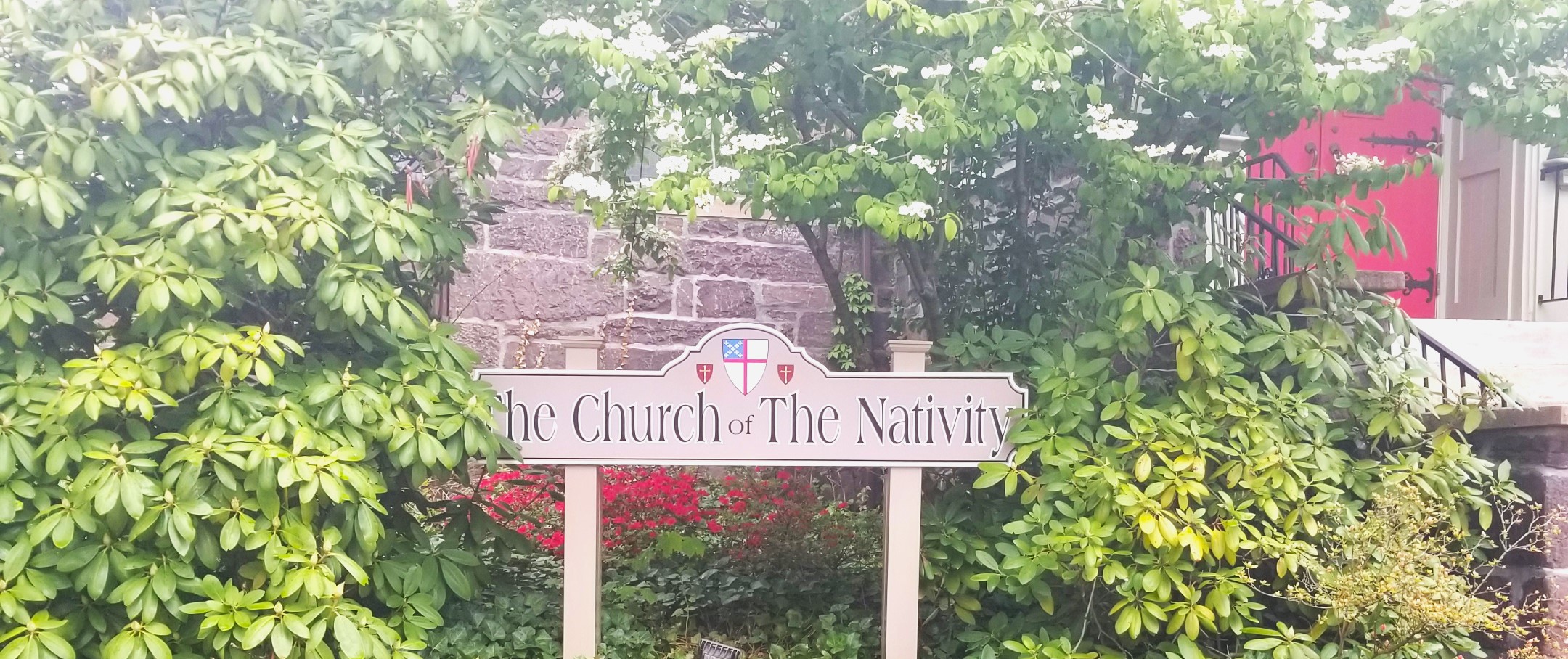
The Church of the Nativity and St. Stephen, Newport, PA
Eighteenth Sunday after Pentecost Track 2 Proper 20
Jesus said to the disciples, "There was a rich man who had a manager, and charges were brought to him that this man was squandering his property. So he summoned him and said to him, "What is this that I hear about you? Give me an accounting of your management, because you cannot be my manager any longer.' Luke 16:1-2
Please be seated.
At the end of his law career, my father was appointed to be a Judge of the Environmental Hearing Board. This is the appeals court for decisions made by the Department of Environmental Protection.
My father loved this position. He’d always been interested in the environment. I remember having discussions during the 1960s and 1970s about how to craft environmental laws and at the same time be aware of their impact on business and commerce. Where was the line or right balance? As a Township Commissioner, my father made sure that housing developments included green spaces in them. My father took seriously the role of being a steward of God’s creation.
My father had Huntington’s Disease and eventually was not able to drive. One year, we went to my Aunt and Uncle’s 50th wedding anniversary party in a town close to Syracuse, New York. We had driven Rt. 81 hundreds of times over the years. I remember what a great thing it was when most of the interstate was completed between here and Syracuse.
If you’ve driven Rt. 81, you know that the Wilkes-Barre-Scranton area is often congested and under construction. When my father could still drive, he’d started taking the Northeast Extension of the Turnpike around Scranton. You can get off Rt. 81 a little north of Wilkes-Barre and take the Extension around Scranton, getting back on Rt. 81 near Clarks Summit.
On this trip to my Aunt and Uncle’s, I, of course, was driving. As we got closer to Wilkes-Barre, my father started insisting we take the Northeast Extension of the Turnpike. I didn’t want to take it, though. I didn’t like this alternative, because I thought it took us too long and too far out of the way if the traffic was not terribly bad. Things were looking good on Rt. 81 and I preferred to stay on the highway.
Plus, I think my goal for a lot of my life was to win an argument with my father. (I don’t think I ever did. Seems like he was ALWAYS right.) I kept insisting that I was fine driving on Rt. 81 and since I was the driver, I should make the decision. But he insisted and insisted. Finally, he said he really wanted to go that way, because he could see how the landfill was doing.
Well, that did it. I stopped fighting him. You see, my father had been a judge in the case regarding the Alliance Landfill near Scranton. You can easily see the landfill from the Northeastern Extension. I can’t exactly remember what the lawsuit was about, but I do recall that the landfill actually looks beautiful. There is green grass covering the garbage in the landfill. There are vent pipes. My father was proud of the work he’d done as a judge to make sure any pollution of groundwater or air resulting from the operation of the landfill was to the minimum allowed by law. He knew that trip to my Aunt and Uncle would be the last one he made and he wanted to see that landfill one more time.
In today’s Gospel, we hear a somewhat confusing story about a manager or steward. Honestly, I wonder if something was lost in translation. Nearly everything I read this week talked about how hard a parable this was and how difficult it was to make sense of it. I wondered why it had been included in the Lectionary. As I continued to read the parable, what came to me was the importance of being a steward of what is entrusted to us from God.
During Jesus’ time a steward was employed by a wealthy person to control the activities of a large household. The steward would direct the household servants and control the household expenses. The steward in today’s parable wasted or misspent the resources put into his care. His employer discovers this poor management and terminates the steward, demanding an accounting of how the resources were used.
The steward is clever, because he knows he will be unemployed, so he thinks of a way to manage the resources to his own benefit by lowering the amounts owed to the employer from various debtors. This way, the steward builds relationships that will help him once he is unemployed.
What came to me as I read and read this passage was the importance of stewardship…active stewardship of all that is entrusted to us by God. The steward in our Gospel was careless with the resources entrusted to him by his employer. He did not manage them well. Once he was caught, he at least managed them, although you might say he managed them to the benefit of himself, rather than to the benefit of his employer. But at least he was actively involved…actively managing.
How are we doing managing or stewarding the resources God has given us? These resources include not only our money, but also our time and our skills. Are we using our money, time and skills to further the Kingdom of God? Are we active in the use of our money, time and skills or are we haphazard, rarely paying attention? Are we focused on using our money, time and skills for things the world expects of us, rather than what God expects of us?
As a church community, how are we doing? During this past year, we had a Facility Condition Assessment conducted, providing us with details about the various facets of our property here in Newport, as well as a 20-year plan for maintenance. Over the next 20 years, we can expect to spend ½ million dollars to maintain this property. That’s not improvements of any kind…just painting, repairs, and regular maintenance. Our property is in excellent shape, fortunately, and it will take an average of $25,000 per year to keep it in good shape.
Our property is a resource and we must ask how we are using this resource to further God’s kingdom? Is the building and what it costs to maintain it, a wise use of the resources entrusted to us for furthering God’s kingdom? I know it’s a provocative statement, but a building is a choice and this building is a choice. If we feel it’s absolutely necessary to have this particular property to further God’s Kingdom here in this place and at this time, we must be willing to pay what it costs to do that.
Recently, I looked at the cost for our building use. We have a mortgage, which we’re paying additional principle on. Each year, we pay $30,000 on the mortgage and it’s now under $150,000. Then there’s the cost for utilities and some routine maintenance. The mortgage, utilities, routine maintenance and major repairs are about $125,000 per year.
Now the building is used maybe 40 hours per week, which includes Sunday mornings, time Michele and I are in the office and some additional hours for additional meetings and gatherings that occur during the week. This means that it costs $60 for each hour the church is open or just over $2,400 per week.
Frankly, I wish our property was used more and I’ve offered it to various groups around the county. Just seems like we spend a lot of money for a few people to use this tremendous and beautiful resource.
And we have added a labyrinth and a community garden. There’s a committee forming to plan for using our outdoor space in ways that enhance our own life together and that enhance the community.
The Environmental Stewardship Committee is looking at our carbon footprint and how we as individuals and as a church community can lessen our carbon footprint. One way is to have more solar energy and we’re interested in leading a community effort to get more solar power to Newport. We’re taste-testing coffee and chocolate today that is grown in ways that support small farmers and support the land.
We are extremely fortunate that the members who went before us were shrewd stewards of their financial resources, putting their fortunes into the care of us, who are members now, and in the care of many generations to come. They embody the tenet of the Iroquois Nation to make decisions and use resources for the benefit of the seventh generation into the future.
We are called to do the same. We are called to be active stewards of all God has provided for us. I use our property as just one example of the resources we have as a church community.
We must take stock of all of our resources and measure their use against the standard of how they serve God and bring God’s kingdom. God asks us to give an accounting of what we’ve done with the resources entrusted into our care. And we want to hear God reply, “Well done, good and faithful servants.” (Matthew 25:23)
Amen