




 Loading...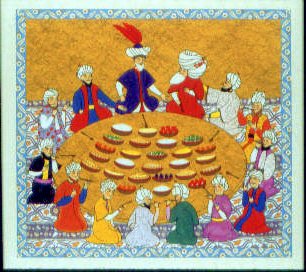
Sermon September 9, 2018
The Rev. Rebecca S. Myers
The Church of the Nativity and St. Stephen’s
Sixteenth Sunday After Pentecost, Proper 18, track 1
http://lectionarypage.net/YearB_RCL/Pentecost/BProp18_RCL.html
But if you show partiality, you commit sin and are convicted by the law as transgressors. James 2:9
But she answered him, ‘Sir, even the dogs under the table eat the children’s crumbs.’ Mark 7:28
Please be seated.
Hodja was invited to a feast in an important and wealthy family's home, but he had forgotten about it.
He was returning from the market when he remembered. "Oh, dear," he said to himself. "I am so late. I won't go home to change my clothes. I will go directly to the dinner". He was in old clothes and they were not very clean.
When he arrived, he waved to his friend, but this friend did not come over to see him. Neither the hosts, nor the other guests paid any attention to him.
The servant placed him at one corner of the table. They didn't ask his opinion on any of the subjects. Worst of all, they forgot to pass him the food trays. The servants ignored him and did not give him any food.
Nasreddin Hodja felt left out. Nobody was showing any respect to him. The servants were passing him by and forgetting to fill his goblet.
After a half hour, Hodja had enough of being ignored and he quietly left the house. He went back to his home and changed his clothes. He wore the best and the newest garments he owned. Then he borrowed a nice coat with real fur trim from one of his rich neighbors. With this new look, he headed back to the banquet.
This time everyone paid attention to the Hodja. The hosts and the servants welcomed him and the other guests treated him with respect. They gave him the best spot at the table and offered him food and drinks. Hodja was pleased with the attention. He started to eat happily and talk with the people.
However, the guests and the hosts soon noticed that, every now and then, the Hodja was dipping the edge of the coat into his plate and muttering "Eat my lovely coat, do eat, you eat too." He took a big leg of lamb and put it inside the coat, saying "Have the best, dear coat." Everyone was curious.
"Hodja Effendi," the host finally asked, "why are you dipping your coat into the food? Why did you put food inside the coat. What is it that you are saying? Are you talking to the coat?"
Hodja was waiting for this opportunity. "I am feeding my coat," he was glad to explain. "When I came before, in my old clothes, I was not given any food or respect or attention. But when I came the second time you treated me as the guest of honor. I have not changed; I am still Nasreddin Hodja. Therefore it must be my fine coat that is the guest of honor. So I must be thankful to my coat. I am telling it to enjoy the food. After all, it is thanks to its beauty that I am being offered all these delicious treats."
https://cmes.arizona.edu/sites/cmes.arizona.edu/files/1.%20Hodja%20Tales%20-%20lesson_0.pdf
This week I thought of this tale from Turkey as I read our Gospel and Epistle. Our human nature is to make judgments about people or situations, sometimes based upon criteria that don’t really matter in the long run. James warns us about this and we have so often heard, “Don’t judge a book by its cover.” Yet, how often do we make judgments without really checking things out?
Our Gospel reading this week is disturbing. Is Jesus really racist? Did Jesus judge a book by its cover? If we take the reading at face value, Jesus does characterize the woman who is a Gentile and Syrophoenician in the way his culture thought of her culture.
“Let the children be fed first, for it is not fair to take the children’s food and throw it to the dogs.” Mark 7:27
Yikes! Was Jesus calling this woman a dog? It’s difficult to hear. Jesus is God come down to earth. Jesus is God coming to live as one of us and we are certainly judgmental people.
Yet, the woman was used to being characterized in this way, I believe. She knew how Jesus’ culture looked upon her and upon her culture. I imagine she had to live in two cultures, possibly. She had to know how to navigate not only the culture that was most familiar to her, but also the culture from which Jesus came. We see this phenomenon today.
This woman…this mother…will do whatever it takes to get the help she needs to save her daughter. She will speak to this man who is a foreigner and does not think very highly of her. Even his characterization of her or his seeming to not offer her any help, does not put her off. She continues to make her case. Well, we may be the dogs, but even the dogs get the crumbs that the children drop on the floor.
You see, this woman knows about Jesus. She has heard about Jesus. She has heard that he can possibly help her daughter. In some ways she sees Jesus more clearly than his disciples do. Jesus heals her daughter. He doesn’t even have to go to the daughter. Jesus answered her request.
So let us examine the judgments we make about others. Let us be merciful and open to challenging our judgments and assumptions.
Amen