

 Loading...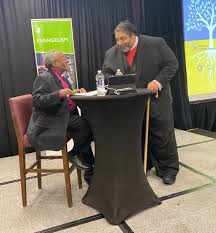
Sermon February 9, 2020
The Rev. Rebecca S. Myers,
The Church of the Nativity and St. Stephen’s
Fifth Sunday after the Epiphany
http://lectionarypage.net/YearA_RCL/Epiphany/AEpi5_RCL.html
If you remove the yoke from among you,
the pointing of the finger, the speaking of evil,
if you offer your food to the hungry
and satisfy the needs of the afflicted,
then your light shall rise in the darkness
and your gloom be like the noonday.
The Lord will guide you continually,
and satisfy your needs in parched places,
and make your bones strong;
and you shall be like a watered garden,
like a spring of water,
whose waters never fail.
Your ancient ruins shall be rebuilt;
you shall raise up the foundations of many generations;
you shall be called the repairer of the breach,
the restorer of streets to live in
Isaiah 9b-12
Please be seated
Recently my Facebook feed was filled with posts and links to a conference sponsored by The Episcopal Church Foundation and held in Atlanta. The title was Rooted in Jesus. By all accounts it was an amazing gathering. Many of the presenters were people I love to hear speak and from whom I have learned much.
One of the podcasts recorded at the conference was a discussion between Bishop William Barber and Presiding Bishop Michael Curry. These two men have known each other for a number of years, because of their time in North Carolina.
Bishop Barber, who is from the Disciples of Christ denomination, was born in Indianapolis. His family moved to North Carolina when he was five to help integrate the public schools there. In 2013, Bishop Barber brought together a large coalition of people to advocate for the very justice we read about in Isaiah today. He and the coalition organized Moral Mondays. Every Monday they would gather at the statehouse in Raleigh, North Carolina, to urge their state government to address a number of issues, including the needs of people living in poverty, the needs of the LGBTQ community, and care of the environment.
In 2014, Bishop Barber founded an organization called Repairers of the Breach. This nonprofit/nonpartisan organization states that it is an
“organization that seeks to build a moral agenda rooted in a framework that uplifts our deepest moral and constitutional values to redeem the heart and soul of our country. We challenge the position that the preeminent moral issues are prayer in public schools, abortion, and property rights. Instead, we declare that the moral public concerns of our faith traditions are how our society treats the poor, women, LGBTQ people, children, workers, immigrants, communities of color and the sick. Our deepest moral traditions point to equal protection under the law, the desire for peace within and among nations, the dignity of all people, and the responsibility to care for our common home.”
https://www.breachrepairers.org/
The organization, in collaboration with others, has launched a Poor People’s Campaign and held national events throughout the United States. A major march will be held on June 20, 2020, in Washington, DC. The campaign continues the work of the Rev. Dr. Martin Luther King, Jr.
In the podcast with Presiding Bishop Curry, Bishop Barber talks about the importance of being pastoral and prophetic and priestly. There is no separation between Jesus and justice. He also cautions that love must be at the center of all of these justice efforts. That we must not become what we are fighting. We must be willing to challenge others AND we must also believe in the redemptive love of Jesus Christ that transforms all of us. We must believe that true love causes transformation.
Bishop Barber explained that he once heard someone say that The Rev. Dr. Martin Luther King, Jr. was assassinated because he was bringing up love in all of the wrong places. The podcast discussion goes on to talk about how that’s what Jesus did…brought up love in all of the wrong places.
As I thought more about the Isaiah lesson, I turned to the writing of Old Testament scholar Walter Brueggemann. He explains that our lesson today grows out of a community where there is a gap between their actual conduct as a community and the intention of the community as expressed in their worship.
The community does all of the “right” things and says all of the right words. We are told they delight in worshipping God. Yet, their behavior is rooted in a lack of neighborly economics. They fast from food, but the writer of Isaiah says God wants them to fast from injustice. Right now there is injustice within their community and it comes in the form of denying some members access to resources necessary for life.
To fast from injustice, the community needs to share abundantly the things necessary for life for everyone in the community. Things like food, shelter and clothing. The true fast is a decision against self –indulgence. The true fast is for community. The true fast understands that we are ALL family and that God has created everything. The true fast has us look at how we treat our family and all that God has created and given to us.
When we work for justice, we build a community that is against selfishness, greed, indifference and exploitation. We work for the world God intends. As the writer of Isaiah says:
If you remove the yoke from among you,
the pointing of the finger, the speaking of evil,
if you offer your food to the hungry
and satisfy the needs of the afflicted,
then your light shall rise in the darkness
and your gloom be like the noonday.
The Lord will guide you continually,
and satisfy your needs in parched places,
and make your bones strong;
and you shall be like a watered garden,
like a spring of water,
whose waters never fail.
Your ancient ruins shall be rebuilt;
you shall raise up the foundations of many generations;
you shall be called the repairer of the breach,
the restorer of streets to live in
Bishop Barber has clearly taken these words to heart and is doing all he can to repair the gap between our actions and the community we live in. Ultimately, love repairs the breach and when we work to repair the breach, we make a new and viable community for all people.
Amen
Podcast between Presiding Bishop Michael Curry and Bishop William Barber: https://www.stitcher.com/podcast/the-way-of-love-with-bishop-michael-curry/e/67075416?autoplay=true
Isaiah 40-66 by Walter Brueggemann. Pgs. 186-192 https://www.amazon.com/Isaiah-Westminster-Bible-Companion-Chapters/dp/0664257917/ref=sr_1_1?keywords=Isaiah+40-66+Brueggemann&qid=1581195670&sr=8-1