

 Loading...
Sermon June 11, 2017
The Rev. Rebecca S. Myers, LSW
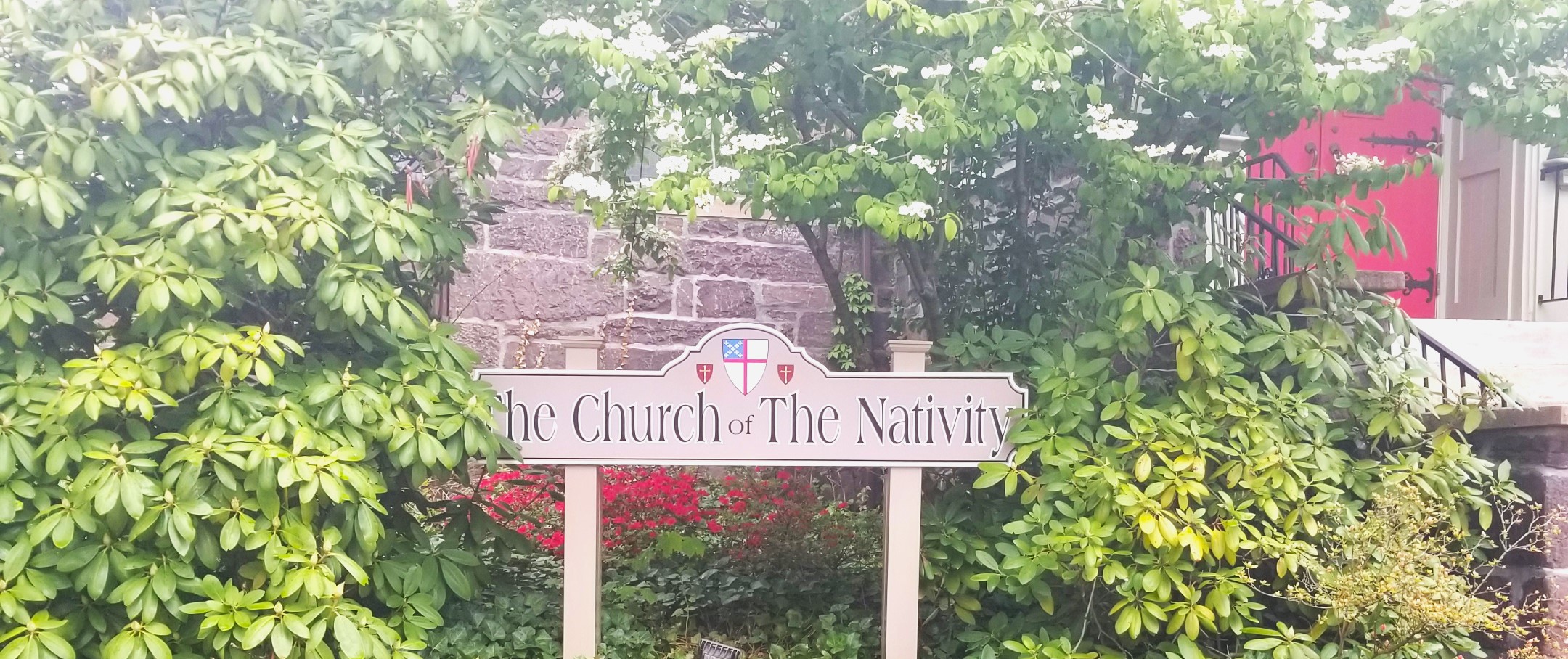
The Church of the Nativity and St. Stephen, Newport, PA
Trinity Year A: //lectionarypage.net/YearA_RCL/Pentecost/ATrinity_RCL.html
Greet one another with a holy kiss. 2 Cor. 11:12
Please be seated.
On October 11, 1996, I traveled from my home in Charlotte, NC to Washington DC for the weekend. This was a very special trip, because I was a volunteer for the last full display of the The Names Project AIDS Memorial Quilt (//www.aidsquilt.org/). There were 37,440, 3’ x 6’ panels on display covering the Mall. My friend, Steward Weaver, had died in April of 1995 and while his name was not on one of the panels, I was there as a volunteer in memory of him.
I first learned of the quilt from my neighbor Barry. Now while I moved to the neighborhood in 1983, I didn’t meet Barry for at least 4 years. You see, we lived on Second Street in Harrisburg, a 3-lane, one-way street. Barry lived across the street, so it took awhile for us to meet. A number of times in those years before we met, there’d be an ambulance at Barry’s house.
When I finally met Barry, I learned his partner had died of HIV/AIDS. The ambulances came because during the course of the illness, his partner had to go to the hospital on a number of occasions. Barry told me many stories about his partner’s amazing, yet short-lived architectural career and about the years Barry cared for him as he died. In those early years, a diagnosis of HIV/AIDS was a certain death sentence and a pretty ugly dying process at that.
I remember attending meetings at Barry’s home, probably regarding starting a chapter of the AIDS Memorial quilt in Harrisburg. The stigma of having the disease was so great that gathering together was comforting and important for those grieving. Many died having been rejected by their families. If they had partners, hospitals often did not allow the partner to make medical decisions for them or even visit, because they weren’t legally married or legally family.
And while the virus can be caught by anyone, especially in those early years, it particularly affected men who were gay. Because the virus was previously unknown and because it affected men who were gay and considered outcasts from society, there was considerable stigma regarding the disease and even neglect and abuse. For instance, in 1987, the United States placed a travel ban visitors and immigrants with HIV. President Obama lifted this ban in 2010. (//www.healthline.com/health/hiv-aids/history#cultural-response5)
Now, many can live with the disease by taking a combination of drugs. The hysteria from the previous years appears gone and the diagnosis is treated like living with any other chronic disease. With the fairly new medicine known as PrEP, it is believed that people at risk for HIV can be prevented from developing the disease. Many are talking about the disease’s eradication.
So much has changed in my lifetime regarding people who are LGBT and now we add Q for questioning or queer and I for intersex.
Yet, so much abuse remains. And I was heartbroken to read an article this past week in The New York Times Magazine, titled, America’s Hidden H.I.V. Epidemic: why do America’s black gay and bisexual men have a higher H.I.V. rate than any country in the world? (//nyti.ms/2s8wuxV).
The article focuses on the ministry of Cedric Sturdevant, currently from Jackson, Mississippi, who drives many miles to make sure men infected with the disease get and take the drugs necessary to prolong their lives. Mr. Sturdevant talks about this call from God and also about his early days as a man who is gay:
“Growing up, I was taught that God was not fixing to forgive a person who was homosexual,” Sturdevant said. “The Bible supposedly said you’re going straight to hell, automatically, there’s no forgiveness. There were several times I thought about suicide. There were several times I wanted to get sick and die. Finally, my thought was, I just want to get out of here.”
Sadly, as much change as we’ve seen, young people still grow up knowing they are LGBTQI and facing great struggle. They are 4 times more likely to attempt suicide. Even when they have the support of family and friends, they often face bullying and are ostracized by their peers, leading to attempts of suicide.
Unfortunately, for many who are LGBTQI, the experience of Mr. Sturdevant is all too familiar. The Episcopal Church is one of the few Christian denominations that stopped this abuse of people who are LGBTQI in our official documents; however, individual parishes are in various places regarding fully welcoming and affirming people who are LGBTQI. I have to admit that I’ve been nervous about openly having this service today and I’m not totally sure where all of you stand or where we stand as a parish.
So what does this have to do with Trinity Sunday and our readings for today?
For one, our worship of a Trinitarian God is not something easily explained with words. It’s one of those things that’s mysterious and lived in and experienced in our spiritual side of ourselves. The Trinity is three persons in one substance.
The Creed of St. Athanasius on pages 864 and 865 of the Book of Common Prayer defines the Trinity.
In part, it says:
And the Catholic Faith is this: That we worship one God in Trinity, and Trinity in Unity, neither confounding the Person, nor dividing the Substance. And the whole three Persons are co-eternal together and co-equal.
Our Trinity of three persons suggest we need to examine the binaries in our lives, including that of gender identity that is only male or female. Three persons in one substance suggests more fluidity.
In addition, from our reading in Genesis today, we hear:
“Let us make humankind in our image, according to our likeness…” Genesis 1:26
How do we deny the divinity in any of us created in the image of God?
Secondly, in Corinthians, Paul encourages us to Greet one another with a holy kiss. What does this mean? (see https://www.gotquestions.org/holy-kiss.html) In that time, it was common for people to greet one another with a kiss to show friendship and affection. This was also done when people parted. A holy kiss was one that was physically pure and morally blameless. It was distinguished from a kiss that is sexual or hypocritical or deceitful.
In Luke 22:47-48, Jesus is in the garden of Gethsemane, and while he was speaking to the sleepy disciples with him, Judas approached to give Jesus a kiss, which would have been a normal greeting amongst the disciples and Jesus. Yet, this kiss of Judas was not a holy kiss and Jesus knew it, saying, “Judas, is it with a kiss that you are betraying the Son of Man?”
The holy kiss encouraged by Paul was important, because many of the early Christians had lost family and friends because of their new faith. They were outcasts and ostracized. In addition, there was controversy about whether Gentiles needed to follow the Jewish ways in order to be fully accepted by the new Christian community. The holy kiss was affirmation of acceptance… of the bonds of the new spiritual community that was the new family and the acceptance that everyone was welcome.
Our holy kiss today, which is often a hug or handshake, means the same thing. It conveys acceptance. It conveys welcome. It conveys that we are one community. For people who are LGBTQI and who often have lost connections with family and friends, and been ostracized from faith communities, the holy kiss has special resonance.
In the name of the Trinity, three persons in one substance, and as followers of Jesus Christ who taught us that loving God and loving one another was most important, let us greet one another and all who are in our community with a holy kiss.
Amen