
 Loading...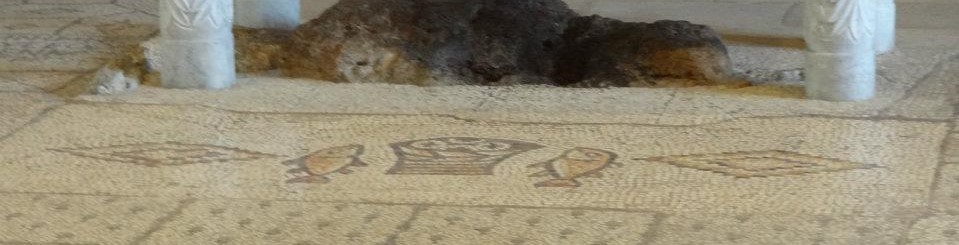
Sermon July 29, 2018
The Rev. Rebecca S. Myers, LSW
The Church of the Nativity and St. Stephen’s
Tenth Sunday After Pentecost, Proper 12, track 1
//lectionarypage.net/YearB_RCL/Pentecost/BProp12_RCL.html
‘There is a boy here who has five barley loaves and two fish. But what are they among so many people?’ John 6:9
Please be seated.
When I visited Israel in 2012, one of my favorite places was the Sea of Galilee. It is a beautiful lake, although not as big as the Great Lakes. You can see across Galilee, for instance. I was inspired to write this poem:
Sea of Galilee
Rebecca S. Myers, June 21, 2012
You come to me in the lake
The cool spring winding its way
Feeding and cooling the lake
From the heat of the Galilean sun
It was here you called your beloved friends
It was here you taught all- both Jew and Gentile
It was here you showed us the abundance of God
The hospitality of God
The graciousness of God
Loaves and fishes
It was here you calmed the storm and
Drove out the unclean spirits
It was here you challenged the pantheon,
The traditions and old beliefs
It was the rocks here
The black volcanic stone
Where you announced your church
It was here you set your face
Through the valley
And hill towns of Galilee
Towards the holy city of Jerusalem
The towns are mostly rubble and rocks
Only remnants remain
Yet the mighty mountains stand witness
Remember you
The spring flows
And the wind whispers your name
The region around the lake is a powerful place. You can feel it.
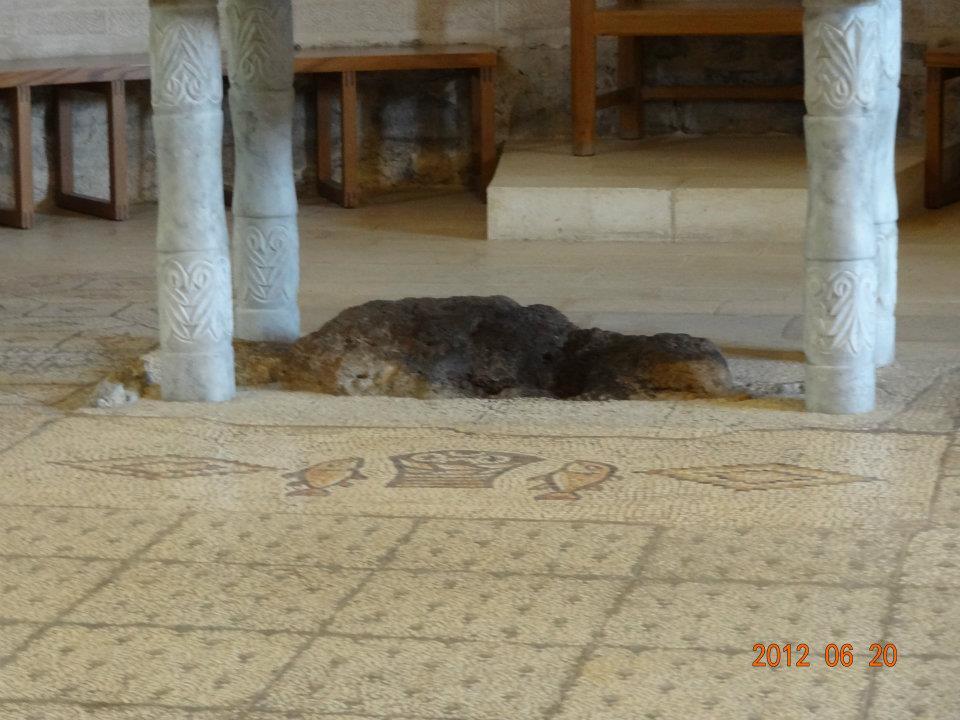
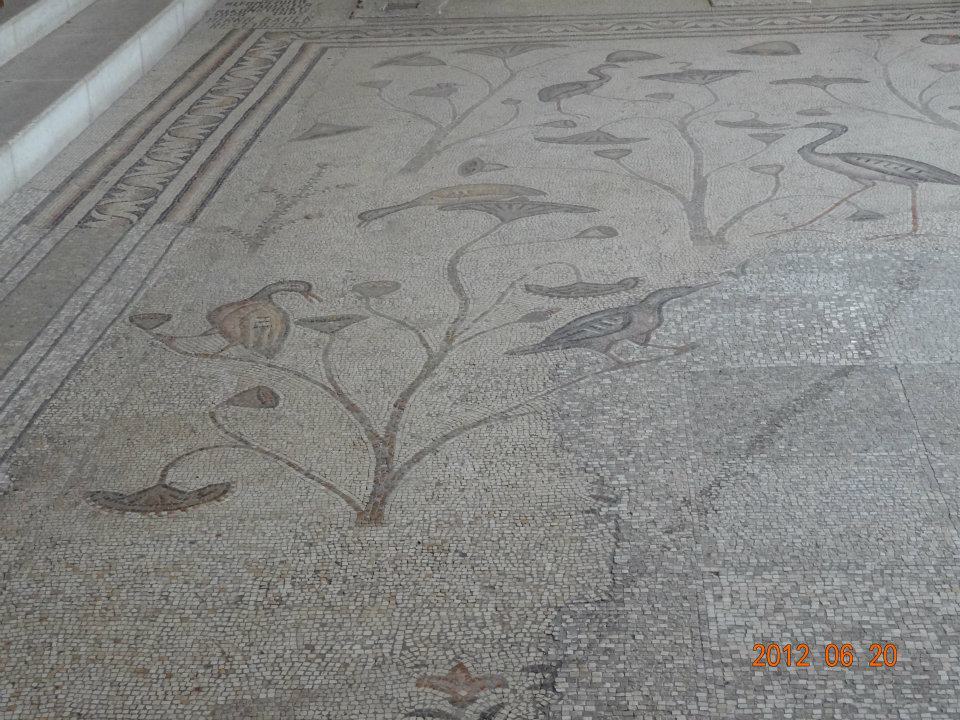
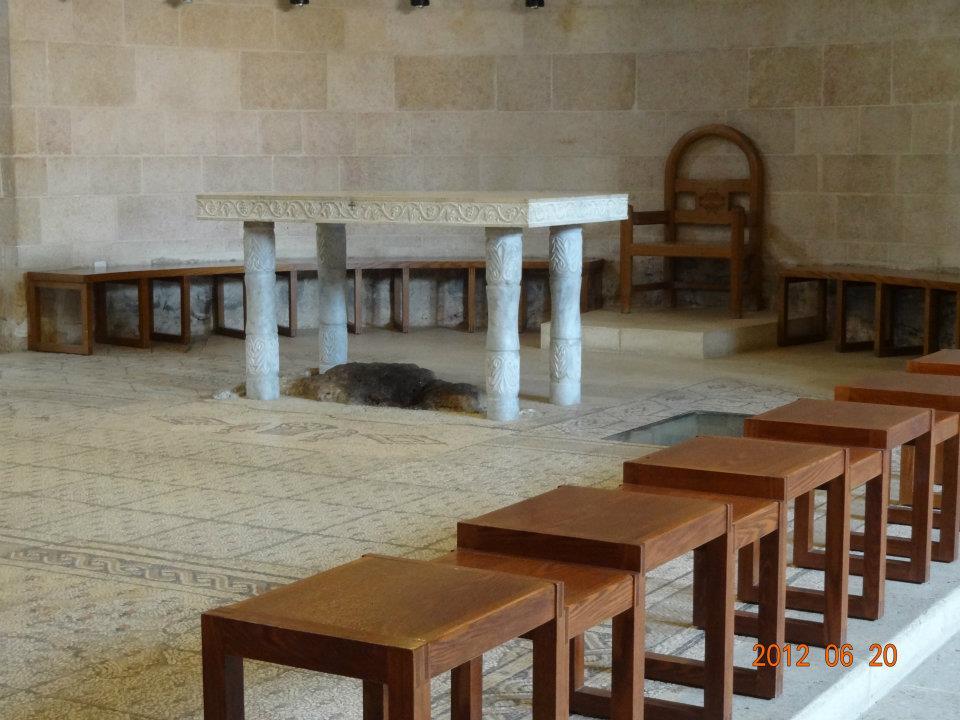
Of course, one of the places we visited was Taghba, the place in our Gospel today. There is a church, familiarly known as the Church of the Multiplication. While the current church was built in the 1980s, earlier excavations showed beautiful mosaics from the sixth century, which are preserved in the floor of the new church.
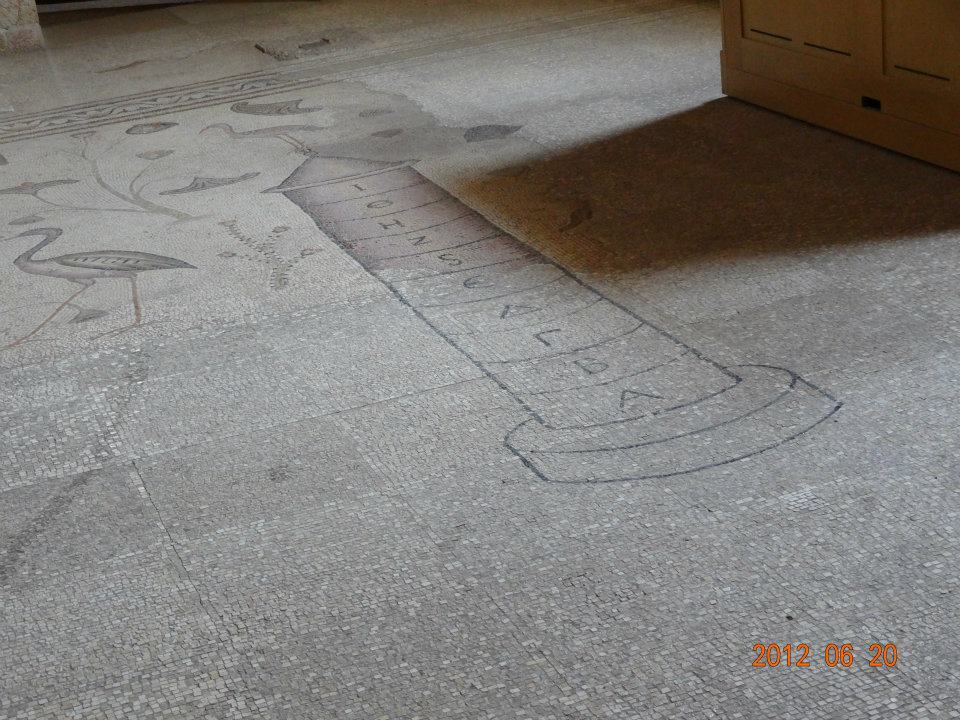
The altar is over an exposed rock, representing the exact place where Jesus multiplied the loaves and fishes. The mosaic in front of the altar shows two fish and a basket with 4 loaves of bread. Wait a minute, shouldn’t there be five? That’s what the Gospel says…there were two fish and five loaves of bread. You see, the fifth loaf of bread is the bread of Eucharist on the altar. As we celebrate the Eucharistic meal, we receive the fifth loaf of bread.
Of course this story has caused much discussion and speculation over the years. How did two fish and five loaves of bread feed all of those people until they were satisfied? And how were there twelve baskets left over?
Yet, when we realize that we partake of the fifth loaf…that we are the fifth loaf even today, we can begin to understand this mystery of abundance.
Just look at what happens within our parish. Right now, the narthex is overflowing with school supplies and there is still one week remaining to bring in supplies. The loaf is multiplied.
During Lent, our area in front of the altar is filled with cans and boxes of food for the Food Bank. Our gorgeous garden is yielding baskets of vegetables that are taken to the Food Bank each week. We have been asked to bring in our extra produce, too. The loaf is multiplied and many are fed.
In early September, we will finalize our Giving to Others (GTO) funds to many worthy causes in Perry and Juniata Counties and our Diocese. The loaf is multiplied.
Each Sunday we gather together. We enjoy each other’s company. We worship and praise God. We are fed and strengthened spiritually. The loaf is multiplied.
Something happens when we gather together. Who can explain it adequately? How can you define exactly what happens? How do we, a fairly small group of people, do so much…probably more than we can ask or imagine? Our generosity and our love of God, our neighbor and each other defies explanation.
The loaf is multiplied and all are fed.
Amen
Photos: Altar at Taghba. Two fish and four loaves. The fifth loaf is the bread of Eucharist.
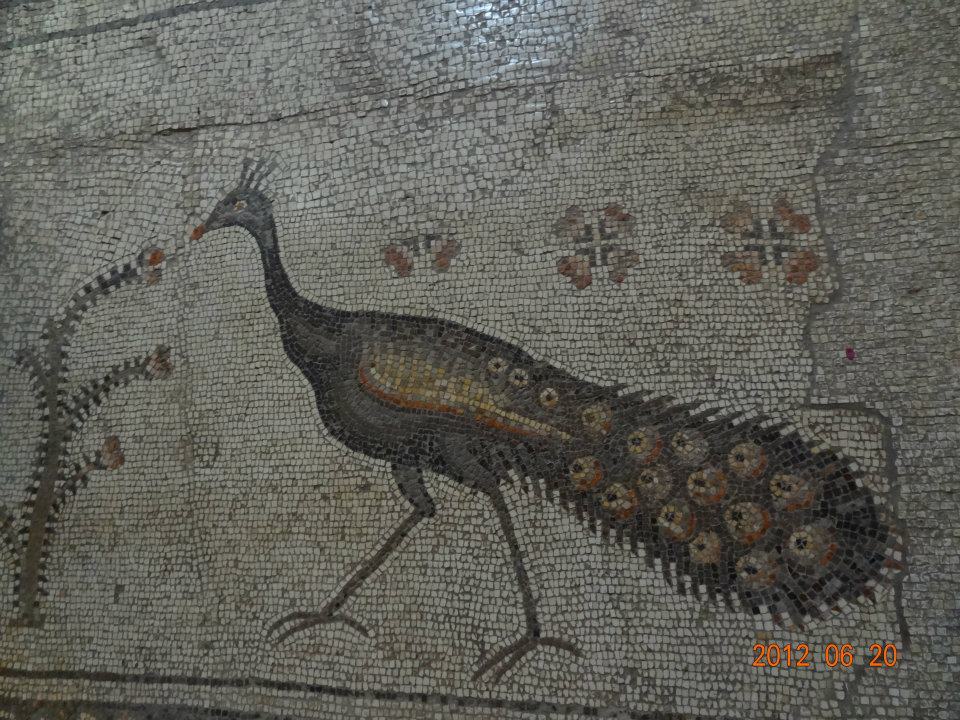
The peacock is a symbol of resurrection. When it loses a feather, a new one immediately grows to replace it.
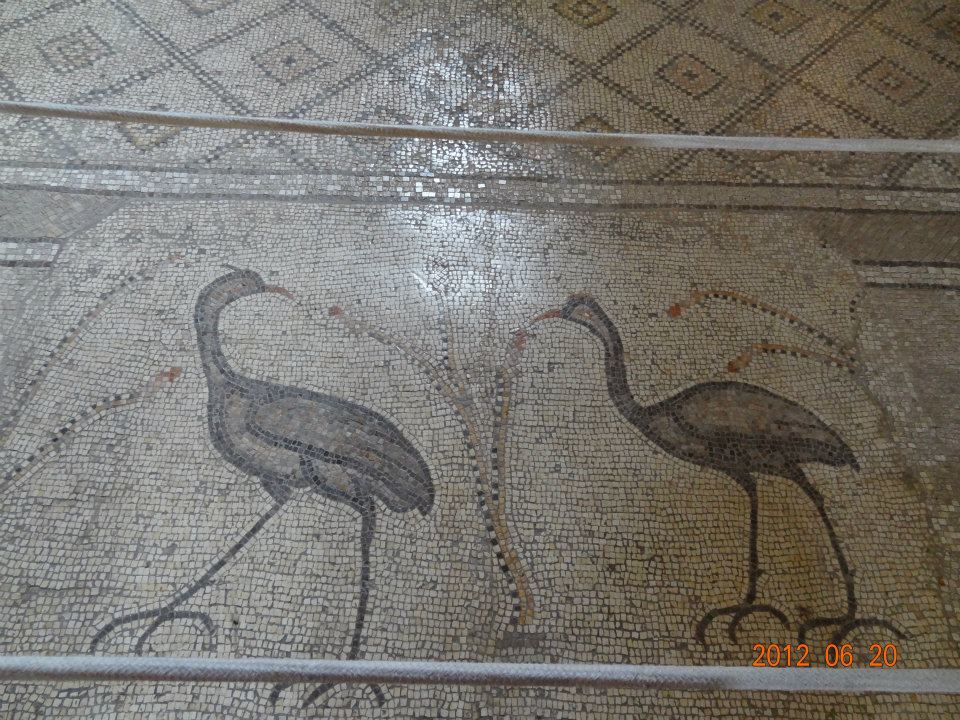
There are lots of egrets and herons in the Holy land.