

 Loading...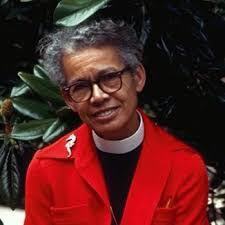
Sermon June 10, 2018
The Rev. Rebecca S. Myers, LSW
The Church of the Nativity and St. Stephen’s, Newport, PA
Third Sunday After Pentecost, Track 1
//lectionarypage.net/YearB_RCL/Pentecost/BProp5_RCL.html
…but whoever blasphemes against the Holy Spirit can never have forgiveness, but is guilty of an eternal sin…. Mark 3:29
Whoever does the will of God is my brother and sister and mother. Mark 3:35
Please be seated.
Imagine being born in 1910 and recognizing from an early age that while you physically looked like a girl, you did not experience yourself as such. Luckily for Anna Pauline Murray, the family who raised her, allowed her to express herself freely. She enjoyed wearing clothes that were more in line with those worn by boys and her family let her do so.
Yet, throughout 75 years of life, Pauli Murray, was challenged by living as her true self. She suffered numerous “nervous breakdowns” and heartbreaks, not only from her own internal struggles, but also from others who did not fully understand or condemned and chastised her for who she was.
While it seems like things are a little better today for people who are gender nonconforming, that is not true in all cases and unfortunately, our Christian religion, supposedly based upon the deep, abiding and nonjudgmental love of Christ, can cause tremendous pain.
How many of you have ever heard of Pauli Murray? I only heard about her in the past decade and then only because she attended General Theological Seminary in the mid 1970s. Yet, she had an amazing career as a lawyer prior to that time. She is someone we should all know.
She graduated from Howard Law School in 1944, the first in her class and the only woman. While in law school, she faced tremendous discrimination, which she labeled “Jane Crow.” She should have had a fellowship at Harvard as a result of her excellent performance in law school, but even with a letter from President Franklin Roosevelt, she could not get in the then all-male school.
In 1950, she published an examination and critique of segregation laws in each state. She suggested the strategy to eliminate these laws should be changed. Up until then, the wisdom was to attack the ruling from the 1896 Plessy v. Ferguson Supreme Court Case, which allowed for separate but equal facilities based upon race. Pauli Murray believed the laws should be challenged directly as unconstitutional, violating the equal protection clause in the 14th Amendment to the Constitution. In essence, separate facilities could never be equal.
Murray’s work, thus set the foundation for the landmark 1954 Brown v. Topeka Board of Education decision that overturned “separate, but equal.”
After that, she began to criticize the federal government for not protecting women against gender discrimination. She persuaded Betty Friedan to join her in creating the National Organization for Women (NOW).
In the early 1970s, then lawyer, now Supreme Court Justice, Ruth Bader Ginsburg, used Murray’s framing of Jane Crow to win her first Supreme Court decision in Reed v. Reed. This established a woman’s constitutional right to equal protection. Pauli Murray was listed on the brief by Ginsburg as an acknowledgement of Murray’s scholarship on the issue.
Throughout these 60+ years of life, Murray was a devout Episcopalian. She even attributed the shaping of some ideas to the Episcopal Church’s understanding of unity in diversity. As her faith deepened, the calling to become an Episcopal priest strengthened. Finally in 1973, The Episcopal Church approved women to be candidates for ordination and Murray matriculated to General Theological Seminary.
Seminary was tough, not only because Murray was one of the first women to attend, but also because she was 63 years old and had so much life experience, compared to others in her class. In 1977, Murray was ordained an Episcopal priest, the first woman who was African-American to be ordained to the priesthood.
At that time, Murray resided in Washington, DC. Being assigned to a church was challenging. Some believe that was attributable to her appearance. By that time Murray dressed more like a man. In addition, she was small and some called her the pixie priest. Someone once called her “Father.”
From her various life experiences, Murray had come to view herself as a bridge, bringing all people together.
Pauli Murray is an example for us today. In our Gospel today, Jesus says that people who blaspheme against the Holy Spirit can never be forgiven. This statement seems totally antithetical to our understanding of Jesus as love and our understanding that God can forgive all, if we ask for forgiveness.
Earlier this week, the clergy of our convocation met and we discussed this. We came to see that tremendous discrimination and harm done against God’s creation is the blasphemy against the Holy Spirit. That’s the unforgiveable sin. I remember hearing that Desmond Tutu says the worst thing we can do to another human being is to make them feel they are not a child of God.
Pauli Murray suffered because she could not fully be herself, because of others, including the church’s view of people who do not conform to the binary of male and female. People still suffer today and when we participate in that suffering, we commit the unforgiveable sin of blasphemy against the Holy Spirit.
This past week, a person told me she knew she was a lesbian as a teenager. She attended her church regularly and loved attending. Yet, one day a fellow parishioner told her that “her kind” was not welcome in the church and she needed to find another place to attend. The woman told me she left and never went back and never found another church, either. The experience was so painful for her and she could not risk being treated like that ever again. When she first came out, she had already been rejected by her family. Her story is not unique and reminds those of us who comfortably attend church and who participated in the ostracism of people in the name of Jesus Christ, that we must ask for forgiveness and be reconciled.
The other thing we hear in this Gospel today is Jesus telling us that blood ties are not the most important ties we have. Indeed, many who are LGBT have been cut off from their families or must pretend around their families. They often must create new families. Jesus tells us that when we follow him, we will have a new family. It is one filled with people who do the Will of God. In other words, we always have our church family, at least when we as the church are at our best in following Jesus Christ.
In the presentation in 1977 at the Church of the Cross, Chapel Hill, North Carolina, The Rev. Dr. Pauli Murray said:
“My entire life’s quest has been for spiritual integration, and this quest has led me ultimately to Christ in whom there is no East or West, no North nor South, no Black nor white, nor Red Christ … only Christ, the Spirit and Love and reconciliation, the healer of deep psychic wounds, drawing us all closer to that goal of perfection which links up to God our Creator and to eternity.” (Jane Crow: The Life of Pauli Murray by Rosalind Rosenberg, p. 378)
Amen