



 Loading...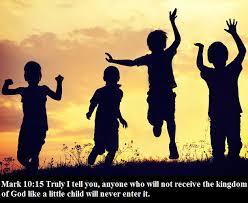
Sermon October 7, 2018
The Rev. Rebecca S. Myers, LSW
The Church of the Nativity and St. Stephen’s
Twentieth Sunday After Pentecost, Proper 22, track 1
http://lectionarypage.net/YearB_RCL/Pentecost/BProp22_RCL.html
Some Pharisees came, and to test him they asked, ‘Is it lawful for a man to divorce his wife?’ Mark 10:2
Truly I tell you, whoever does not receive the kingdom of God as a little child will never enter it.’ Mark 10:15
Please be seated.
I was in high school when I bought this little book. It is called “The War Prayer” and it is by Mark Twain. The Vietnam War had not ended and public opinion was against our involvement in Vietnam. I was wrestling with the whole concept of war. Was going to war the right thing to do or was I totally a pacifist against war and even violence of any kind?
Mark Twain wrote “The War Prayer” in 1905 and it was not published until 1916, six years after his death in 1910. He knew this piece would make people so very angry that it could not be published while he was alive.
In this poem, Twain creates a picture of a community ready to send its members off to fight a war. He captures the fervor, both religious and patriotic, that is part of the church service meant to encourage and pray for those soldiers.
In the midst of the long prayer, a stranger enters the church. Twain describes him thus:
An aged stranger entered and moved with slow and noiseless step up the main aisle, his eyes fixed upon the minister, his long body clothed in a robe that reached to his feet, his head bare, his white hair descending in a frothy cataract to his shoulders, his seamy face unnaturally pale, pale even to ghastliness.
The stranger goes to the front as the preacher keeps praying and then asks the preacher to step aside. The stranger stands at the pulpit and says he is a messenger from God. The stranger explains to the startled parishioners:
“[God] has heard the prayer of His servant your shepherd, and will grant it if such be your desire after I, His messenger, shall have explained to you its import — that is to say, its full import. For it is like unto many of the prayers of men, in that it asks for more than he who utters it is aware of — except he pause and think.
“God’s servant and yours has prayed his prayer. Has he paused and taken thought? Is it one prayer? No, it is two — one uttered, and the other not. Both have reached the ear of Him who heareth all supplications, the spoken and the unspoken. Ponder this — keep it in mind. If you would beseech a blessing upon yourself, beware! lest without intent you invoke a curse upon your neighbor at the same time. If you pray for the blessing of rain on your crop which needs it, by that act you are possibly praying for a curse on some neighbor’s crop which may not need rain and can be injured by it.
The stranger then goes on to explain the true ramifications of the prayer…the devastation that this war will cause to the “enemy.” Claiming God for their cause also prays for the destruction of the other…the enemy. It is a hypocrisy of the love of God as taught to us by Jesus Christ.
In our Gospel today, the Pharisees come to test Jesus. Jesus has left Capernaum, the town on the shores of Galilee in Northern Israel. He and his followers have traveled south on their way to Jerusalem, where Jesus knows he will face a horrible death. The Gospel says that the crowds gathered around him once again and once again, Jesus taught them.
Then some Pharisees come to test Jesus. Sure, they are wondering who is this man that draws crowds wherever he goes? The Pharisaic community was having a debate, however, about the legitimate grounds for divorce. They want Jesus to choose a side. They do not even consider what choosing a side in this debate means for the other group or for their human community as a whole. Which side are you on, Jesus?
Each side uses scripture to frame their argument. The 24th Chapter of Deuteronomy appears to allow for divorce and provides procedures that must be followed. Yet, Genesis chapter 2:24 states, “Therefore a man leaves his father and his mother and clings to his wife, and they become one flesh.”
The Pharisees are caught up in what is legally allowed; however, Jesus is concerned with what God commands and what the love of God commands.
Now, this passage is always difficult for me to preach upon, since I have been divorced twice. Yet, what Jesus is focused upon is our humanness. God is unity, grace, goodness; yet we as God’s creation sometimes rupture human relationships. We are not always about love, unity, grace and goodness. Therefore, we set up laws by which the legal contract of marriage can be broken.
And yet, as Lamar Williamson, Jr., in his commentary on Mark states:
“A divorce may revoke a legal contract, but one cannot un-live the vital ties created by life together in marriage, however painful they may be.” P. 178
The legal contract of marriage is broken through a divorce, but there is an emotional and spiritual reality of having spent that time of our lives together, whether that time was joyful or horrible or somewhere in between. And I imagine, even in death, when one partner dies, the other partner continues to have a spiritual and emotional connection to their partner.
So, we might say that divorce is a sign of our brokenness as human beings and of the ways we find it difficult and challenging to live with each other.
Also in our Gospel today, Jesus says we must be like children in order to receive the kingdom of God. What is it about the example of children that we are to understand? Children must rely upon adults. Yes, children have things they can do when it comes to taking care of themselves. They can get themselves dressed and eventually get themselves breakfast at least. Yet, for many activities of their daily lives, they must depend upon adults.
And so it is with us. We do have our responsibilities in this life and we cannot do everything on our own. We also must rely upon God and put our trust in God.
Today we have a very real and tangible way to demonstrate our reliance upon God. That is in our pledge. Hopefully you’ve picked up your materials this morning. You will find information about how we plan to spend our financial resources in 2019 to further the mission of the church. There is also a sheet where you can tell us how you plan to spend your time, and talent and spiritual resources during 2019. All of them should be turned in by October 28, when they will be blessed.
Making a pledge is tough. We don’t know what the next year will bring. We step out in faith. We also put this in writing and a few other people see it… Michele, Wendy, me, maybe the counters. Pledging pushes against our notions of privacy and how we talk about money.
Some people are afraid they will be treated differently according to the size of their pledge. Honestly, I personally don’t care about the size of your pledge at all. That is between you and God. I do care about you and how you are doing spiritually and how you are doing in your relationship with God. Pledging and fulfilling your pledge is just one way you let me know how you are doing.
I know some of you do not pledge. We make a promise to do something and maybe we won’t be able to keep it. Or maybe we don’t like other people to know what we give to the church or we don’t like to use envelopes or we can’t remember to bring an envelope. But pledging is an important spiritual practice. It’s not about the amount so much; it is about making a promise to God and to this community. Therefore, I encourage you to take what you were going to put in the plate one Sunday in October and put that down as your pledge and that you’ve paid for the whole year. See what that feels like to sign your name and fulfill that promise. You can always keep giving over and above that pledge amount. Just make a commitment in writing and fulfill it.
If you were here last week and her JD Stillwater, you heard that we are just stewards of all we have in this lifetime. We are just trustees. Coming from that place of a child who must rely upon God, how will you steward your financial, time, talent and spiritual resources for the work of this community of Nativity and St. Stephen during 2019?
That is the question posed by the materials in your envelope.
Our church community provides a place for us to be in relationship with each other in ways commanded by God through the teachings of Jesus Christ and the movement of the Holy Spirit. May we not put God to the test. May we examine our prayers to God to acknowledge the spoken and unspoken requests we make. May we acknowledge deep in our souls both our responsibilities to and our reliance upon God.
Amen
Text of The War Prayer: https://warprayer.org/
Quote from Interpretation: A Bible Commentary for Teaching and Preaching: Mark by Lamar Williamson, Jr., 1983, John Knox Press