


 Loading...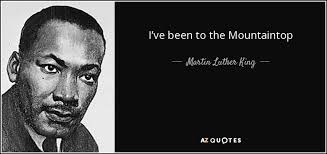
When I watched clips of the Michael Cohen testimony, I was interested in how race was dealt with between the Democratic and Republican representatives. I also recently read an article where an Alabama newspaper editor urged the KKK to ride again to DC gated communities calling for the mass lynchings of Democrats. and later for only hanging. Socialist communists. I read in another article on Penn Live that PA ranks 8th in the country with 36 active hate groups. I began to think about the actions, speeches, and writings of Martin Luther King
In 1952, after several effective, but increasingly contentious years, Dr. Vernon Johns left Dexter Avenue Baptist Church in Montgomery, Alabama and was followed by Dr. Martin Luther King, Jr. Before too long the eloquent and inspiring messages of Dr. King had people on the mountaintop. But looking down from the mountain, King saw people, who couldn’t eat in restaurants, he saw people who had to stand outside waiting for a bus. He saw grown men slip into a back alley, because there were no restrooms that they could use. He saw women who had to drink from rusty corroded fountains. He saw children with tears in their eyes, because the public playground wasn’t for their kind of people. He saw a woman on a bus refuse to move to the back. He saw people being beaten and people being killed and one day he decided that it was time to come down from the mountain.
In 1968, Dr. King was one of the most recognized black leaders in America. He had spoken to thousands at one rally in Washington, DC; he had one the Nobel Peace Prize. By 1968, he left the Dexter Avenue Baptist Church and was serving the church his father had served, Ebenezer Baptist Church in Atlanta. It was another kind of mountaintop, but he still managed many trips down the mountain, the final one being in April of that year. The night before he left to attend a rally for sanitation workers in Memphis, Tennessee, the plane he would be flying had to be checked for bombs after being guarded all night. The day he arrived in Memphis, threats were being phoned in and tensions were high, but Dr. King spoke that night and these are the last words of the speech he gave.
“I don’t know what will happen now. We’ve got some difficult days ahead. But it doesn’t matter with me now. Because I’ve been to the mountaintop, and I don’t mind. Like anybody, I would like to live a long life. Longevity has its place. But I’m not concerned about that now. I just want to do God’s will. And He’s allowed me to go up to the mountaintop. And I’ve looked over. And I’ve seen the Promised Land. I may not get there with you. But I want you to know tonight that we, as a people will get to the Promised Land. And I’m happy tonight. I’m not worried about anything. I’m not fearing any man. Mine eyes have seen the glory of the coming of the Lord.”
Today’s Gospel is also about a mountain top experience – the Transfiguration. While Jesus was praying, the appearance of his face changed, and his clothes became dazzling white. Then Moses and Elijah appear and talk with Jesus about his departure – literally his exodus or his coming death in Jerusalem. Only Luke includes this information about the content of their conversation, and it is only in Luke that Moses and Elijah appear “in glory.” These two figures link Jesus with Israel’s past and show that Jesus was in accord with the Law and the prophets. Jesus will also face rejection as did Moses and Elijah.
Suddenly Peter, “not knowing what he said,” proposes that they erect dwellings on the site in commemoration of the three figures. Although Peter had previously confessed Jesus as Messiah, he still did not comprehend that Jesus was far superior to Moses and Elijah or that this experience could possibly be contained or preserved.
At this point the disciples are terrified as they are overshadowed by a cloud. The cloud is a manifestation of the presence of God. A cloud led the Israelites in the journey through the wilderness and would appear again at the Ascension of Jesus.
Then a voice came from the cloud saying, “This is my Son, my chosen listen to him. These words echo those spoken at Jesus Baptism however this time they are heard by Peter, James, and John. Jesus is not only the Beloved, but the chosen of God. And they are to listen to him.
Jesus is not just another prophet; he is the Son of God. He has revealed to them that the Messiah will be killed and then raised on the third day. To be a disciple is to take up the cross and follow him.
I’ve been on the mountaintop, Dr. King said shortly before his murder. From there on privileged heights, he saw the promised land of transformations – another way – another hope – another kingdom.
The mountain is a place of visions. It was on the mountain that Jesus became transfigured before his disciple’s eyes, his human and familiar face, now dazzling as the sun, the ordinary clothes shimmering in light. He was in conversation with the great ones, Moses and Elijah, and out of the cloud comes the voice: “This is my beloved son on whom my favor rests. Listen to him.
On this Transfiguration Sunday how do we listen to the voice of God? I would suggest that Dr. King by his life and death gives us an example. I would also like to suggest that Dr. King’s mountain top experience began shortly after he agreed to be the spokesman for the Montgomery bus boycott following Rosa Parks refusal to move to the back of the bus. Dr. King began receiving nightly calls from people threatening to kill his family.
Unable to sleep and tormented by visions of his little girl suffering, King broke down one night in his kitchen. As David Garrow writes in his biography of King, at that moment King heard an inner voice saying, “Stand up for justice, stand up for truth… It was the voice of Jesus saying to fight on. He promised never to leave me, never to leave me alone.” From that moment of King’s mountain top experience, the voice in the kitchen was King’s anchor.
The boycott lasted 362 days. On December 21, 1956, after the Supreme Court had declared unconstitutional the laws requiring segregation on buses, blacks and whites rode the buses as equals. Following the boycott in the eleven-year period between 1957 and 1968, King traveled over six million miles and spoke over 250 times, appearing wherever there was injustice, protest, and action. He was arrested more than twenty times, assaulted at least four times and at age 35 became the youngest recipient of the Nobel Peace Prize.
On the evening of April 4, 1968, while standing on the balcony of his motel room in Memphis where he was to lead a protest march in sympathy for the striking garbage workers in that city, he was assassinated.
While we will probably not have mountain top experiences which will lead to the Nobel Peace Prize, for each of us there is at least one mountaintop. God speaks to us and we respond. God gives and we receive. Some of us will go the mountain in church, while worshipping on a morning such as this; others will go to the mountain in a quiet moment of prayer and reflection. Others will encounter God by giving and receiving love. Still others will hear God’s call in and through lives of service or being there for those who need us or volunteering. There are no shortages of mountaintops.
No matter how glorious Jesus’ transfiguration may have been for him, no matter how ecstatic it may have been for the disciples, the point is that none of them remained on that mountaintop. They all went back to work.
No matter how intriguing and stimulating the mountaintop experience may have been, there were still sick people to be healed and lost souls aching for God’s love and presence in their lives. There were still those wanting to follow Jesus with all of their heart mind and soul. There still are. There was a world full of brokenness and pain. There still is.
Jesus did not wear his dazzling garb in everyday life, but took his place next to the poor and needy. Those who followed him then and now follow him do not live in the splendor of mountaintop experiences. I can’t speak for you, but probably less than 2 per cent of my life is spent in mountaintop experiences.
I would suggest that while these experiences can be life changing as Dr. King’s experience in his kitchen that night was, God does not want us to stay there. Dr. King did not stay in his kitchen, but came off that mountaintop experience and went into the world.
The mountaintop experiences of our lives are important, but these signs of divine action are not the things that truly change us in the long run. They may be crucial events that get our feet moving in a different direction, but true change is gradual, often painful process as it was with Dr. King.
But we are changed by the simple act of following Jesus, by going where he goes and doing what he says: feeding the hungry, welcoming the stranger, caring for the sick, comforting the dying, praying for our enemies, telling the truth no matter what it costs.
When we stand on the mountaintop of faith in those special moments with God, we can see the plans that require our faithfulness. We can see the people we need to be praying for, people we need to be caring for and the people we need to be helping. And sometimes we’ll get it right and sometimes we might get it wrong, but if we do nothing, nothing will happen in and through our lives. But when you and I trust Jesus on the mountain, who came to Dr. King in his kitchen that night, we will be on holy ground, we might be worried, but we won’t worry about the wrong things, we might fear for the body, but we will never fear for our souls, because our eyes have seen the glory of the coming of Christ.
My friends, to be transfigured and transformed by the power of God are not something we can understand or explain or make happen. Instead it happens to us as we offer ourselves as a channel of God’s grace in our world. In the wilderness of Lent that now stretches before us let us take the time to be holy - time to become faces of holiness for others as Jesus was for his disciples and Martin Luther King was for the civil rights movement.. May it be so for you and for me. Amen.