



 Loading...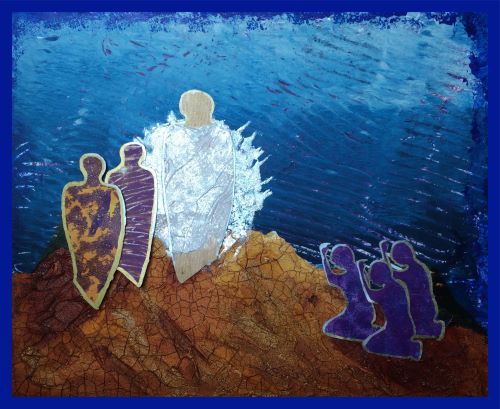
Sermon February 19, 2023
The Rev. Rebecca S. Myers, MSW
The Church of the Nativity and St. Stephen’s
The Last Sunday after the Epiphany
https://lectionarypage.net/YearA_RCL/Epiphany/AEpiLast_RCL.html
Audio: /documents/Eucharist__February_19__2023
Video: https://youtu.be/tWw3FnjudhU
As they were coming down the mountain, Jesus ordered them, ‘Tell no one about the vision until after the Son of Man has been raised from the dead.’ Matthew 17:9
Each year on this last Sunday after the Epiphany, we hear some version of the Transfiguration. The event is told not only in the version in Matthew that we heard this morning, but also in Mark and Luke, with little variance.
Jesus and his followers are traveling to Jerusalem. Peter has just declared that Jesus is the “Messiah, the Son of the Living God (Matthew 16:16.) Jesus starts telling his followers what will happen when they get to Jerusalem. In verse 21 of Chapter 16, we hear: “From that time on, Jesus began to show his disciples that he must go to Jerusalem and undergo great suffering at the hands of the elders and chief priests and scribes, and be killed, and on the third day be raised.”
Peter who had just made the amazing proclamation that Jesus was the Messiah and son of the living God, rejects what Jesus is telling his followers. Jesus rebukes Peter with the familiar words, “Get behind me, Satan! You are a stumbling-block to me; for you are setting your mind not on divine things but on human things.” In other words, Peter understands some amazing things about Jesus, but cannot even comprehend the full truth.
But that doesn’t stop Jesus from continuing to expose Peter and, in the occurrence we call the transfiguration also, James and John to some really incredible experiences. Experiences that are hard to explain and even terrifying at first. In Luke’s account Peter James and John do not tell anyone what they’d seen and we assume it is because how could it be explained and how could they be believed?
In Mark and Matthew, Jesus tells them not to tell anyone until after the resurrection. Peter, James and John could barely understand what Jesus meant when he said he would rise from the dead; much less explain what they had just experienced.
It is the wisdom of Jesus throughout his ministry and life with us that he truly understands what we have the capacity to process and how we process.
I was so struck by Jesus’ saying that Peter, James and John shouldn’t tell anyone what happened up on that mountain. Obviously at some point, they did tell what happened, because it is in the earliest Gospel of Mark and then nearly the same in Matthew and Luke. I imagine in the context of the resurrection and Jesus’ appearances afterwards, the followers could more fully understand and believe what Peter, James and John saw on that mountain.
Sometimes we just cannot comprehend the full depth of what we see, or claim it as true.
This led me to explore how our minds work and I found an interesting article about how our experiences and the way we live affect how we see and interpret what happens to us. For instance, our eyes take much longer to process things and interpret them, so often we make assumptions about what is happening and what will happen next. This is necessary if we want to hit a baseball with a bat for instance. Our processing time would lag too much, so we predict the path of the ball, for instance.
And remember a few years ago when there was the argument about whether that dress was blue or white? One researcher found out that some of that depended upon whether you were a night owl or early riser. In interpreting photos, we need to filter out some of the light, based on whether we think the dress is bathed in sunlight or artificial light. Those assumptions change the color of the dress in our minds. In the article I found, there are so many illusions. It’s truly mind boggling.
The author gives this sage advice:
“…the illusions and the science behind them raise a question: How do we go about our lives knowing our experiences might be a bit wrong?
There’s no one answer. And it’s a problem we’re unlikely to solve individually. I’d suggest that it should nudge us to be more intellectually humble and to cultivate a habit of seeking out perspectives that are not our own. We should be curious about our imperfections, as that curiosity may lead us closer to the truth. We can build cultures and institutions that celebrate humility and reduce the social cost for saying, “I was wrong.”
This isn’t easy. Our psychology makes it hard.”
Another neuroscientist explains, “We have this naive realism that the way we see the world is the way that it really is. Naive realism is the feeling that our perception of the world reflects the truth.”
Today we are reminded of how following Jesus brings surprises and sometimes confusing experiences into our lives…things we do not know how to interpret or explain. Being in a faith community helps, right? We can get perspectives that are different from ours. And maintaining an attitude of humility and openness to new understandings always helps.
In the end, when we keep following Jesus, we will be changed.
Amen