


 Loading...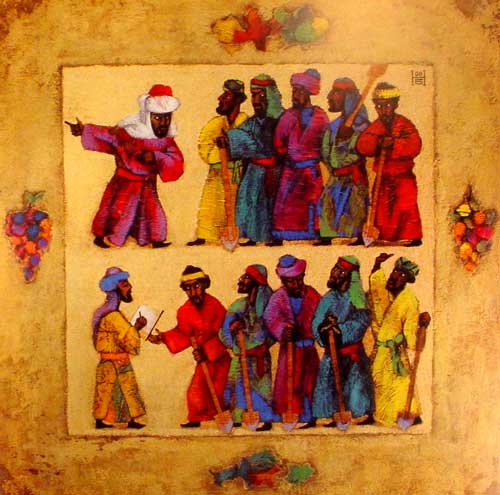
Sermon September 20, 2020
The Rev. Rebecca S. Myers,
The Church of the Nativity and St. Stephen’s
Sixteenth Sunday After Pentecost, Proper 20, Year A, Track 2
Observance of Latinx Heritage Month
http://lectionarypage.net/YearA_RCL/Pentecost/AProp20_RCL.html
Audio: /documents/Eucharist_September_20__2020
Video: https://youtu.be/aM3AZpnJFv8
Only, live your life in a manner worthy of the gospel of Christ, so that, whether I come and see you or am absent and hear about you, I will know that you are standing firm in one spirit, striving side by side with one mind for the faith of the gospel…Philippians 1:27
When those hired about five o’clock came, each of them received the usual daily wage. Matthew 20:9
Please be seated.
Today we observe Latinx Heritage Month. This week, I’ve been thinking about Caesar Chavez, who worked most of his life advocating for appropriate wages and for safe working conditions for people working in the fields in California. I remember him for the “no Grapes” boycott of California grapes, due to the pesticides used, which created unsafe working conditions for the pickers.
In today’s Gospel, we once again hear a parable about the kingdom of God. Jesus says God’s community is like the landowner who needed laborers for his fields. All throughout the day, the landowner hires laborers, even until one hour prior to the end of the day.
What caught my thinking this week was the phrase “usual daily wage.” All of the laborers received the “usual daily wage” no matter whether they were hired in the morning or at the end of the day.
One commentary I read talked about the “usual daily wage” being exactly what every person needs to live. While those who started work first thing in the morning grumble about being paid only the “usual daily wage,” commentator John Shea says, “What is just for the landowner is always ‘the usual daily wage.’ This is what people need in order to work in the vineyard, and this is what is always given.” (On Earth as it is in Heaven: The Spiritual Wisdom of the Gospels for Christian Preachers and Teachers, Year A, p. 282)
Shea reminds us that in the prayer Jesus taught, we pray “give us this day our daily bread.” Our daily bread; not our weekly or monthly bread, but food for today. Everyone needs food for today, right now.
Everyone needs safe housing and housing for the climate where we live. Everyone needs clean air to breathe. Everyone needs clean water to drink, cook with and bathe in and even play in. We need clothing and education and meaningful work. Many of these are codified in the International Covenant on Economic, Social and Cultural Rights (https://www.ohchr.org/en/professionalinterest/pages/cescr.aspx)
In recent years, this “usual daily wage” has been named a living wage or what is required for people to have a “satisfactory standard of living” that prevents them from falling into poverty. https://www.investopedia.com/terms/l/living_wage.asp
According to a 2016 report, Latinx people are more likely to work in lower paid occupations, receive lower wages and have higher unemployment. That was in 2016, so imagine what it is today with the pandemic?
The community also faces pressures related to immigration. Just this past week, a federal appeals court ruled that the current administration was within their rights to revoke temporary protected status for certain groups of people who legally immigrated due to unrest or natural disasters in their home countries. Many of the 400,000 people affected by this court ruling have been in our country legally for decades. They have homes, occupations, businesses and families. Yet, by March of 2021, most of them must go back to their “home” country voluntarily or face deportation. The ruling is expected to affect 200,000 children born here in the United States. Families face the decision about whether the children stay here and become separated from their parents and families or whether they return to a country where they have never lived.
And it is not easy and may be nearly impossible for those affected to become permanent citizens. Recently naturalization fees have been raised, some substantially. At least 100,000 of those affected by the court ruling work in occupations deemed “essential” during the pandemic. The U.S. Chamber says some business sectors such as construction will be adversely affected. Many of the countries are not prepared nor able to absorb the people who would be returning.
We also know that families have been separated and detained, sometimes in cages, at our southern border.
In the reading from Paul’s letter to the Christian community in Philippi, Paul gives us the advice to live our lives in a manner worthy of the gospel of Christ. The work for the “usual daily wage” or living wage is living our lives in a manner worthy of the gospel of Christ. Work to address our broken system of immigration is living our lives in a manner worthy of the gospel of Christ. Work to make sure families can stay together is living our lives in a manner worthy of the gospel of Christ.
When we live our lives in a manner worthy of the gospel of Christ, we stand firm in one spirit and strive together with one mind for the faith of the gospel. This justice work is work given to us from God.
Amen
2016 Report on Hispanic Workers: https://cepr.net/images/stories/reports/hispanic-workers-2016-11.pdf
New York Times Article: https://www.nytimes.com/2020/09/14/us/immigrants-temporary-protected-status.html?searchResultPosition=1